What Enterprise Application Integration Actually Means
Only 28 percent of enterprise applications are currently connected to each other.
Somebody on the finance team is exporting the CRM data into a spreadsheet again. Enterprise application integration exists as a category because manual copy-paste processes are widespread across companies that use multiple software tools.
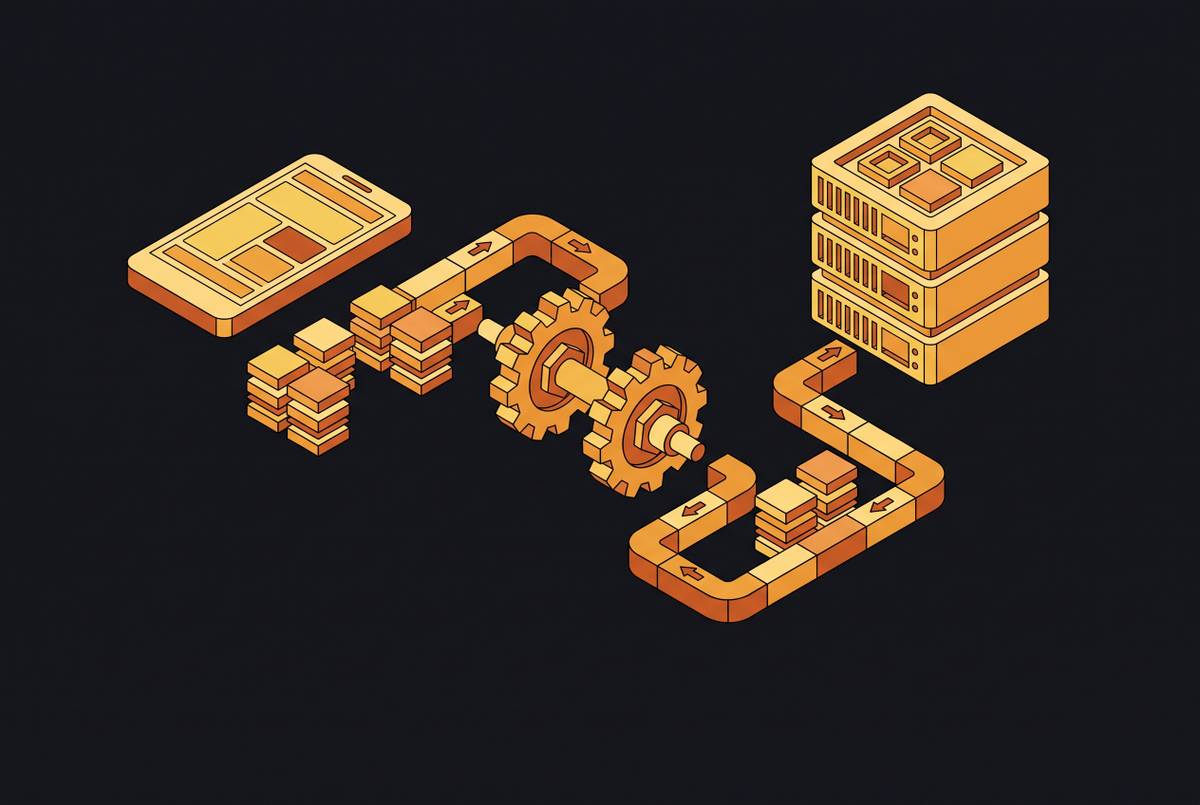
EAI is the combination of methods, tools, and frameworks that let multiple business systems communicate and exchange data reliably, without manual handoffs or rewriting the core applications.
That second part matters more than it sounds. Nobody's rewriting the ERP from scratch just so it can chat with the CRM. The connective tissue sits in a layer between the applications, not inside them. The systems stay exactly as they are. Something else does the work of getting them to cooperate. Cambridge Business English Dictionary defines it in plain terms as "the process of connecting all the software and computer systems used by an organization so that information can easily be found and shared".
Disconnected Systems as a Structural Problem
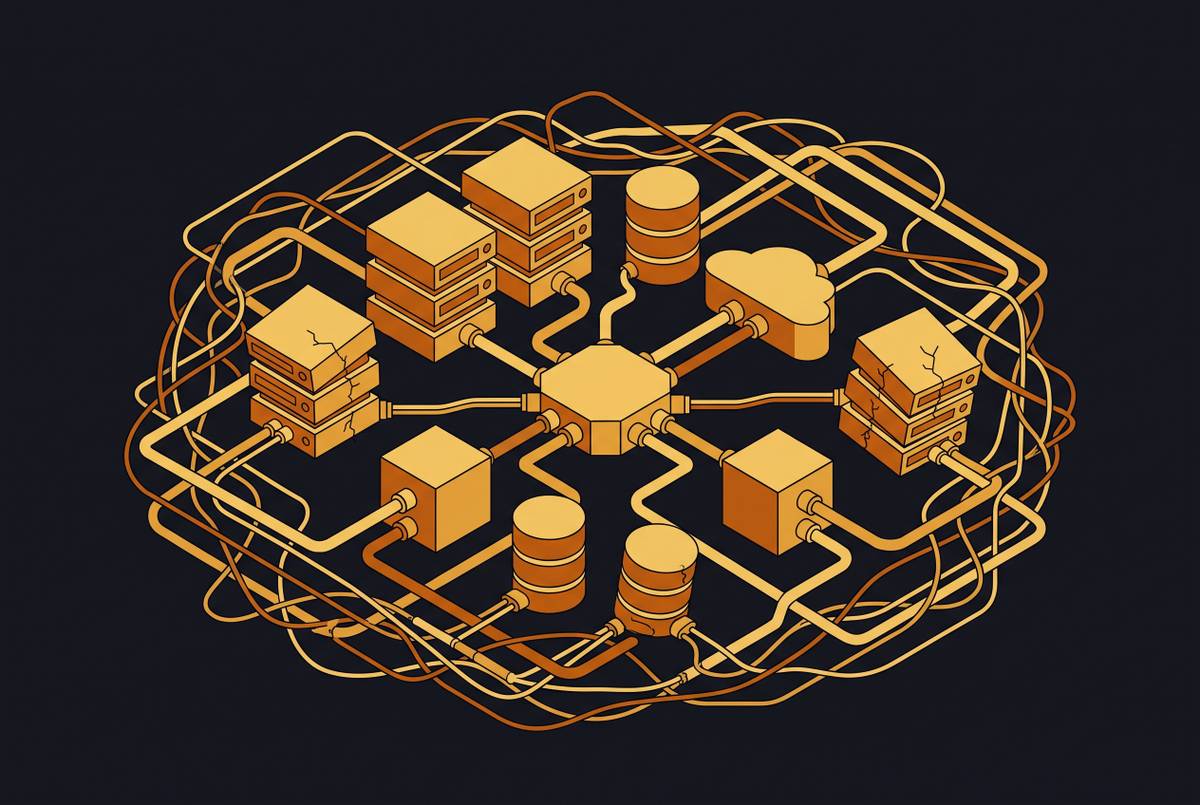
Finance runs one system, HR runs another, supply chain has its own, the CRM is off doing its own thing, and analytics sits somewhere trying to make sense of all of it after the fact. None of them talk. Practitioners call this the "islands of automation" problem. Islands don't build bridges on their own.
The result isn't just annoying, it's expensive in ways that compound. A process that should take one click instead takes a spreadsheet, an email, and significant manual effort.
The systems themselves present further obstacles. Different operating systems, different database formats, mismatched date formats, ancient codebases nobody at the vendor supports anymore. None of this was designed to talk to anything else because, at the time it was built, it didn't need to.
The math turns genuinely ugly. If you connect applications directly, point to point, the number of connections doesn't grow with the number of apps. It grows with the number of possible pairs of apps. Ten applications, connected directly to each other, requires 45 unique links. Bump that up to 20 applications and you're looking at 190. That's a geometry problem, and geometry doesn't scale gracefully.
Codewave's research put a number on how bad the disconnection actually is in practice: only about 28% of enterprise applications are currently connected, and most organizations say that gap is actively slowing down other tech initiatives, AI adoption included. Unito's data adds an uncomfortable finding: 80% of businesses still build at least some integrations in-house, through custom code and manual patchwork. That approach works fine right up until the app count crosses some invisible threshold, after which the maintenance burden becomes the whole job.
The delivery models' evolution: from custom scripts to cloud-native platforms
Every stage of EAI's evolution exists because the previous stage broke under its own weight.
Stage one: point-to-point integration. A script extracts data from system A, reformats it, and loads it into system B. This works for two systems.
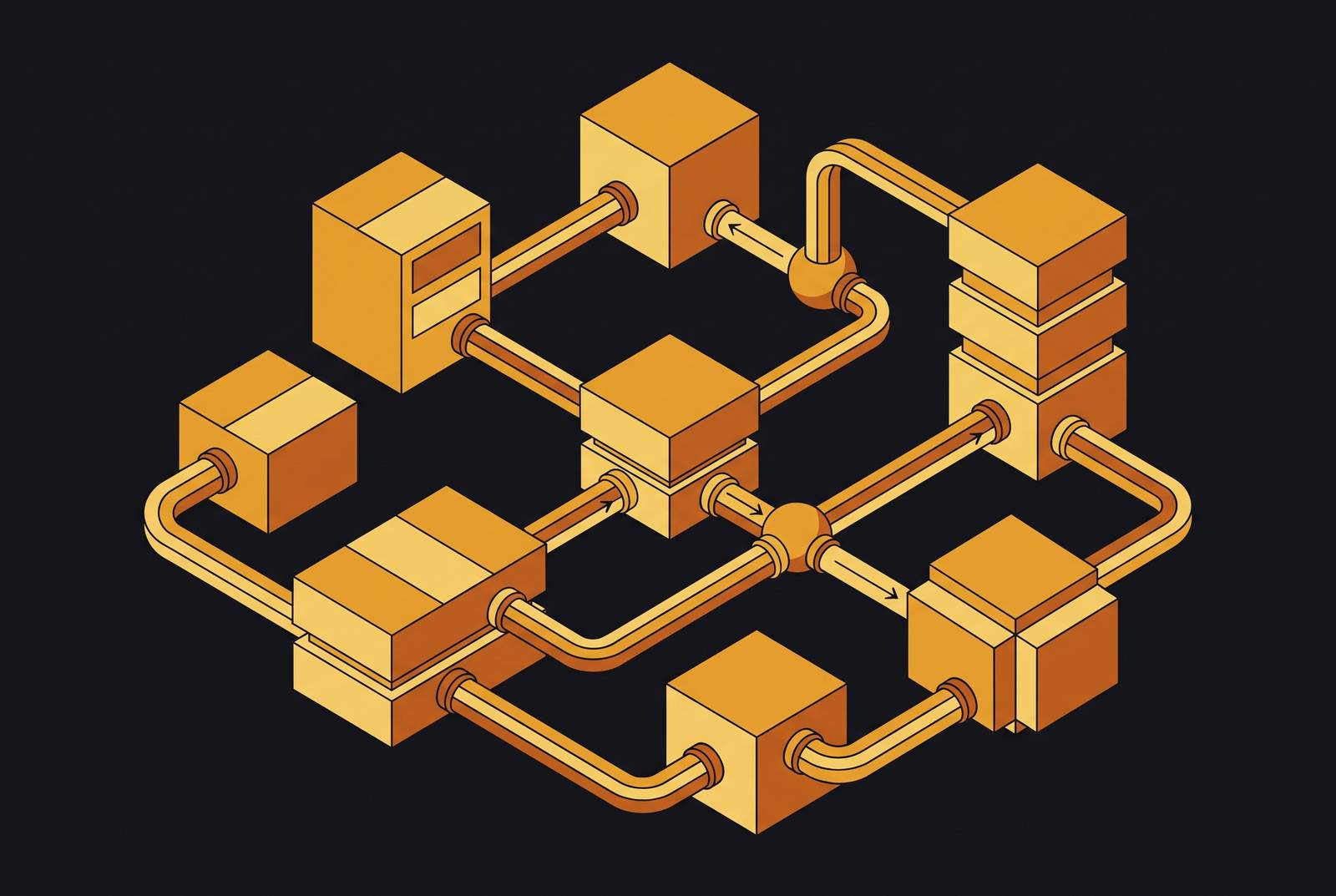
Stage two: hub-and-spoke. Instead of every app talking directly to every other app, a central hub does the talking, and each application only needs one connection to the hub rather than a direct line to every peer. Fewer connections, cleaner architecture.
Stage three: the Enterprise Service Bus, or ESB. This is message-based routing with transformation baked in. Applications publish messages to the bus, and the bus figures out where they need to go and translates them along the way. For a long stretch, this was the dominant pattern for heavyweight, on-premise EAI at large companies.
Microservices are small, independent services that capture data in the cloud and share it through APIs and standard protocols, suited to cloud-native architectures.
The cloud-native shift to iPaaS, integration platform as a service, replaced much of that complexity with prebuilt connectors, low-code/no-code interfaces, templates, and AI-assisted mapping. Per Workato, the delivery models evolved through five distinct stages. Traditional EAI meant enterprise middleware from vendors like IBM, Oracle, TIBCO, and SAP, with six-figure implementations, dedicated integration teams, and months-long timelines.
The terminology tangle: EAI, iPaaS, middleware, & APIs are not interchangeable
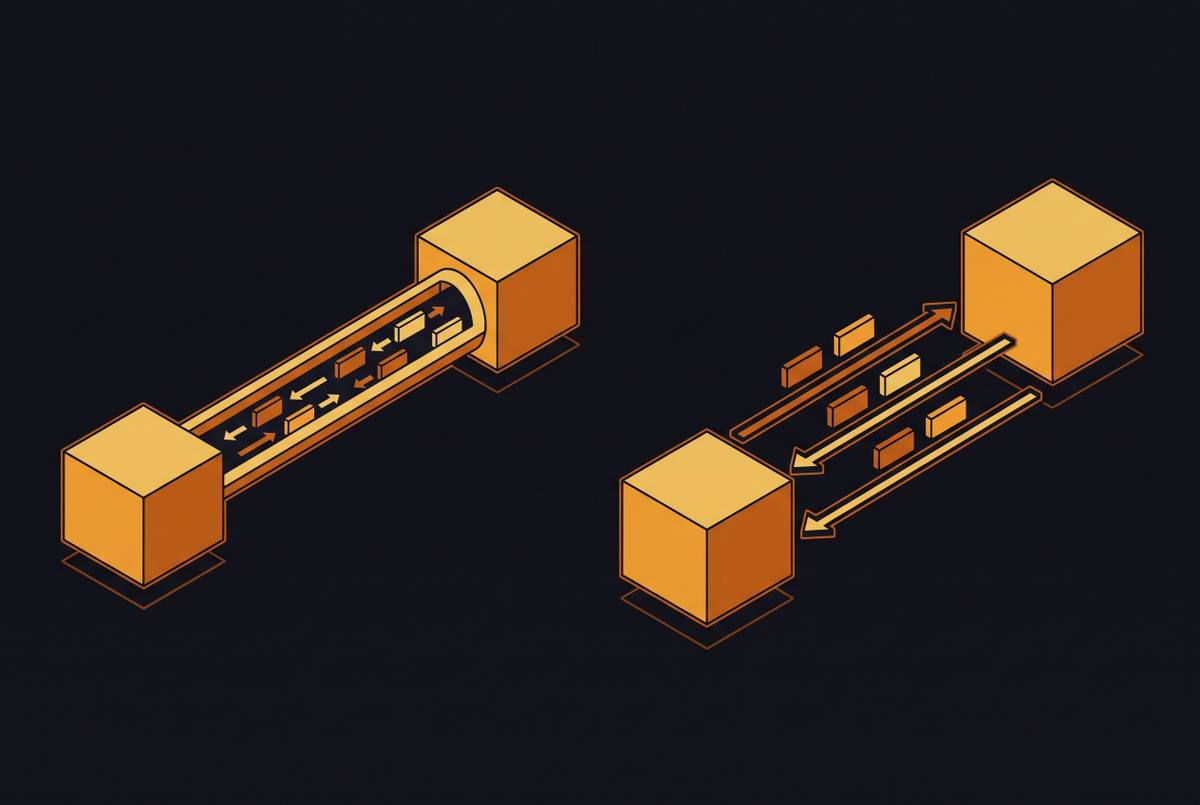
These aren't synonyms. EAI is the goal, not a product. It describes what you're trying to achieve, unified data flow across your systems, not any specific piece of software you buy to get there. Middleware is the software layer that physically sits between applications. It handles asynchronous or complex multi-step flows that a simple API call cannot.
APIs handle synchronous, point-in-time requests. One system asks, another answers. Useful and necessary, but not a stand-in for middleware when the process needs orchestration across several systems at once, or when it can't happen in a single request-response round trip.
iPaaS is the modern, cloud-delivered way most teams now actually buy EAI capability, wrapping a unified interface, prebuilt connectors, low-code tooling, and AI-assisted setup into one product. MuleSoft, Workato, and Jitterbit all sit in this category. ESBs and iPaaS are both technically middleware. The difference is delivery model and implementation weight, not what they're fundamentally for.
Syncing tasks between two project management tools does not justify the cost or complexity of a full iPaaS deployment, let alone traditional EAI middleware.
The six integration patterns & their fit criteria
Point-to-point: direct, simple, and appropriate for two systems that are stable and unlikely to change. The moment a third system enters the picture, reconsider.
Hub-and-spoke: a central hub with adapters out to each application. Cuts the connection count sharply and works well when one team owns integration centrally.
Middleware-based, or ESB: message-oriented routing with transformation and protocol translation built in. This is the pattern for heterogeneous environments where legacy systems and modern ones have to coexist and where volume is high.
Service-oriented, or API-led: microservices plus API gateways. Fits cloud-native architectures where systems were built from day one with the expectation of being connected to other things.
Event-driven: systems publish events, and downstream actions fire automatically, without polling or waiting for a nightly batch job. This is how real-time data flow actually happens across an organization.
Cloud-native: integration logic runs as cloud workloads that scale horizontally, suited to multi-cloud setups and companies that have largely moved away from on-premise infrastructure.
API-bolt-on: AI capability added to an existing system through an API, without restructuring the underlying architecture.
Embedded copilot: AI assistance layered directly inside an existing application's interface.
Agent workflow: an orchestrator with tool access that coordinates across systems, reads the CRM, checks the ERP, sends the email, updates the ticket, often running on Model Context Protocol (MCP) servers.
Pipeline rewrite: tearing down an existing data or integration pipeline and rebuilding it around AI-native tooling from scratch.
Which pattern fits depends entirely on how much of the existing architecture you're willing to modify. Bolt-ons are cheaper and faster to implement. Pipeline rewrites are neither, but they're what agentic AI increasingly demands. Four AI integration patterns are emerging, per S1 research.
The size and drivers of the EAI market
Analysts don't agree on exactly how big this market is, but they agree on the direction. The dollar figures differ across firms because each one draws the category boundary in a slightly different place, but all are describing a multibillion-dollar market moving upward.
The primary driver is application sprawl. Zylo's 2025 report found large enterprises run an average of 660 applications, and Codewave's research confirms large organizations routinely operate hundreds of applications spread across departments. Every one of those apps is a potential integration point.
Generative AI adoption is adding further momentum. Companies plugging AI into existing workflows still need that AI to communicate with the same ERP, CRM, and data systems already in use. AI doesn't remove the need for integration. It adds a new set of systems and processes that require it.
Geographically, Mordor Intelligence puts North America at a 37.60% share of the EAI market in 2025, which tracks with the region's cloud budgets and API-first practices. Asia-Pacific is projected to grow fastest, at a 16.05% CAGR, largely because organizations there are skipping legacy infrastructure phases entirely and building multi-cloud environments from the start. Precedence Research, using a broader application integration scope, projects strong growth through 2035, reflecting the expanding scope of integration work.
Integration project breakdowns: governance, talent, & data quality
When integration projects fail, the postmortem rarely cites software failure. It usually identifies unclear ownership and poor coordination across teams.
Jitterbit's 2025 Automation Benchmark Report found a large majority of organizations still lack any end-to-end automation platform, that most of the automation burden falls on IT teams alone, and that nearly all IT leaders agree non-technical staff should be able to manage integrations themselves. Almost nobody has built that capability yet.
Talent is its own bottleneck. A shortage of qualified EAI specialists affects roughly 40% of integration projects, according to Business Research Insights, causing delays and pushing companies toward third-party vendors they might otherwise have avoided.
Integration touches IT, business units, security, and compliance simultaneously. Without clear ownership, the project stalls no matter how capable the platform is. Buying a well-regarded iPaaS product doesn't resolve disputes between two departments over who owns the canonical customer record.
Maintenance is another underestimated cost. Integration isn't a project with a fixed end date. Connections need monitoring, updates when the APIs on either end change, and troubleshooting when data stops flowing. Security and compliance obligations, including GDPR and HIPAA, add constraints to what data can move where and how.
Organizations that treat reusable API assets as strategic infrastructure rather than one-off scripts routinely report meaningful reductions in integration timelines. Getting governance right compounds over time. Codewave, in January 2026, identifies practical failure modes, including legacy systems without modern APIs that require custom adapters to connect.
Agentic AI & Integration Requirements in 2026
There is a real difference between generative AI and agentic AI. Generative AI writes content and answers questions. Agentic AI plans, executes, and adapts autonomously to complete multi-step work across several systems, and this demands a fundamentally different kind of infrastructure.
Gartner's numbers make the pace of this shift concrete: 40% of enterprise applications are expected to include task-specific AI agents by the end of 2026, up from less than 5% in 2025.
Those agents need programmatic access to ERP platforms, CRM databases, data warehouses, communication tools, and compliance systems, all of which were built for humans navigating a web interface, not autonomous software making API calls at machine speed and machine volume. Rate limits, access controls, and authentication systems that were adequate for a person logging in occasionally were never designed for an agent making hundreds of requests per minute. The infrastructure doesn't need minor extensions. It needs rearchitecting.
AIWorldMeter's data confirms this: integration challenges rank as the top barrier for 46% of enterprise leaders, and data quality requirements affect 42% of AI agent deployments. Agentic AI depends on real-time, accurate data to make reliable decisions. Stale or inconsistent data doesn't just cause one bad decision; it propagates errors across every automated step downstream. The integration gaps that were merely inconvenient under a human workflow become genuinely risky under an autonomous one.
Per Kai Waehner, integration, workflow redesign, real-time data architecture, and organizational change are the real bottlenecks in AI deployment, not technology quality.
Choosing an integration approach that fits your situation
Start with an honest assessment of how many systems actually need to communicate, and how often.
If the answer is two systems with occasional data exchange, a lightweight API connection or a simple automation tool is sufficient. If the answer is dozens of systems, some legacy and undocumented, some cloud-native, all needing to exchange data continuously, that situation calls for a middleware or iPaaS solution rather than a custom script.
Next, consider who will maintain this in a year. A script one engineer wrote and nobody else understands creates long-term risk. If the organization cannot staff ongoing monitoring and updates, that constraint alone should push the decision toward a managed iPaaS platform rather than a custom build, because the vendor is then responsible for keeping connectors current.
Factor in what's coming, not just what exists today. If AI agents are on the roadmap, the integration layer being chosen now needs to tolerate machine-speed, machine-volume access later. Retrofitting authentication and rate limits after the fact is more costly than designing for those requirements from the start.
Finally, establish governance before touching a platform. Assign clear ownership over shared data definitions. Decide, in writing, which team is accountable when a downstream report breaks because an upstream field changed format. No tool survives an organizational structure with no clear owner for the data it's meant to carry.
The right approach is the one sized to the actual number of systems, the actual maintenance capacity, and the actual pace of change the organization can sustain.
Sources
- Enterprise Application Integration definition | Cambridge English Dictionary
- Enterprise Application Integration: What Every IT Leader Should Know in 2026 - Enterprise Application Integration: What Every IT Leader Should Know in 2026
- What Is Enterprise Application Integration (EAI)? - Unito
- Enterprise Application Integration (EAI): A Complete Guide
- What is Enterprise Application Integration (EAI)? | Jitterbit
- Enterprise Application Integration Market - Trends & Companies
- Enterprise Application Integration Market Size, Share & Growth | CAGR of 15.42%