WebSocket vs REST API
Pick the right protocol by understanding how often your server needs to push data to clients.
Developers keep asking which is better, WebSocket or REST, and that's the wrong question. The right one is simpler: which data-flow pattern does your feature actually need? Once you know who has the news and how often it shows up, the protocol picks itself.
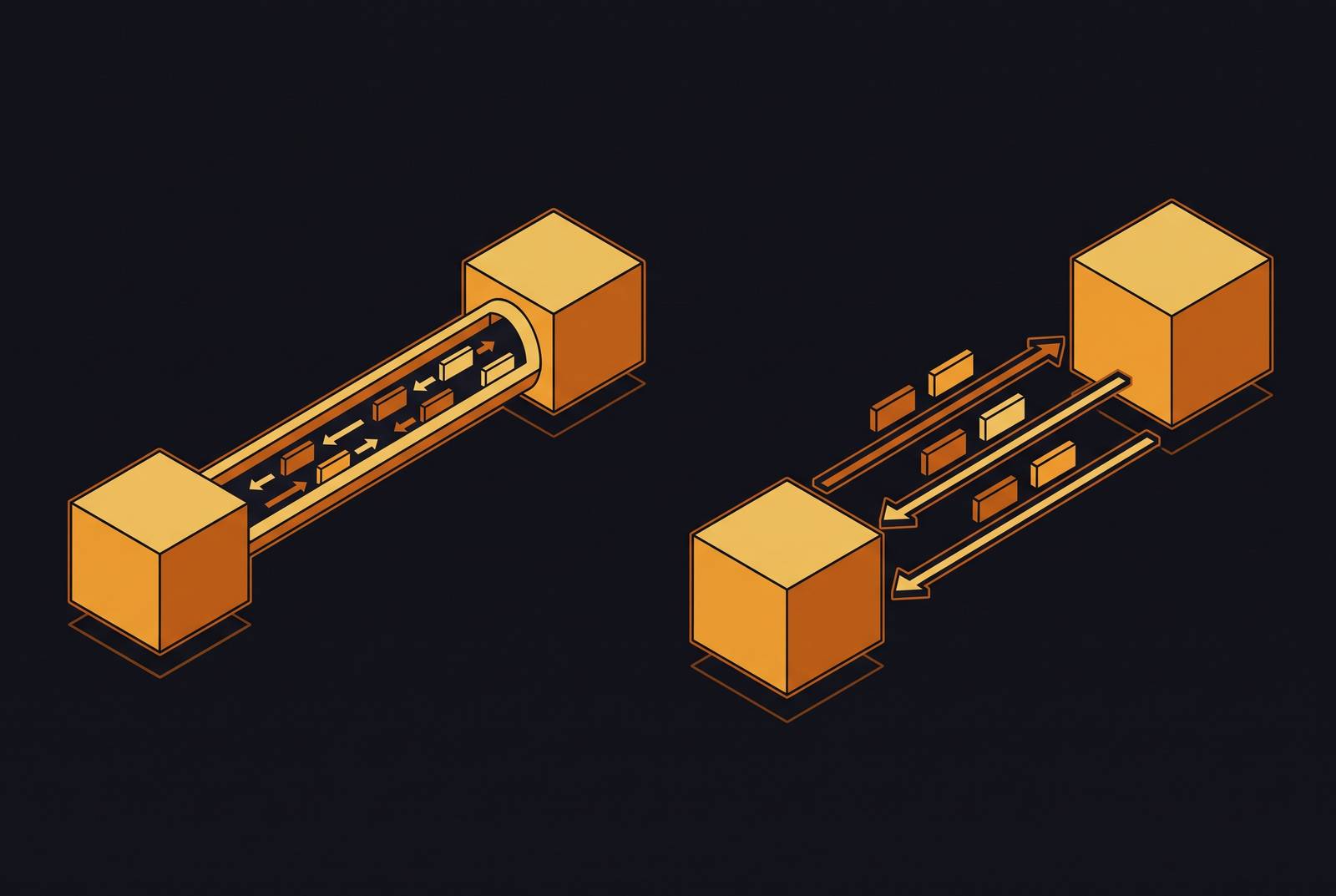
REST is an architectural style built on top of HTTP, request in, response out, done. WebSocket is a persistent, two-way TCP connection that starts life as an HTTP handshake (that's RFC 6455 for anyone keeping score at home) and then lets the server talk whenever it wants, not just when it's asked. That's the entire structural difference: REST makes the client ask every single time. WebSocket lets the server tap you on the shoulder.
Most production systems end up running both, side by side, each doing the job it's actually good at. This piece walks through where each one wins, where neither wins, and what to reach for when that happens.
How REST's stateless model creates its advantages and its hard ceiling
Every REST request carries everything it needs: auth, headers, body. No server-side session hanging around waiting to be remembered. That statelessness sounds boring, but it's the whole reason REST scales the way it does.
Because no server needs to "remember" a client, any request can land on any machine behind a load balancer. Horizontal scaling becomes almost trivial, just add more servers. GET responses can be cached by CDNs and browsers without any special coordination. Retries, logging, monitoring, all the standard HTTP tooling just works, because the entire ecosystem was built around this exact pattern for thirty years.
Here's the ceiling, though: the server can respond, but it can never initiate. It can only wait to be asked.
So what happens when the server has news and the client has no idea when to check? Polling. The client asks, over and over, "anything new?" and the server says "nope" the overwhelming majority of the time. Websocket.org reports that this pattern produces roughly 80 times more overhead than keeping a WebSocket connection open, and that cost also reaches beyond latency. Compute is spent repeatedly generating "nothing new" responses for no reason.
Add to that the header payload REST repeats on every single request (cookies, auth tokens, content-type, the works) and at high request volumes that overhead adds up fast. None of this is a flaw to patch. It's a signal. When you hit this ceiling, it means your feature's data-flow pattern has outgrown what REST was built to do.
How WebSocket's persistent connection changes the economics of real-time data
A WebSocket connection starts out looking like a normal HTTP request, just with an Upgrade: websocket header and a Sec-WebSocket-Key. The server replies with 101 Switching Protocols, and from that moment on, the same TCP connection carries WebSocket frames in both directions, no more handshakes required.
That one-time handshake is where all the savings happen. After it, per-message overhead drops to somewhere between 2 and 14 bytes of frame header. No cookies. No auth header. No round trip to reopen anything. Authentication happens once, at connection time, and the session context just stays attached to the socket for as long as it's open.
The real structural gain is that the server can push a message the instant it has one. No polling, no waiting to be asked. Latency drops to roughly the time it takes the message to physically get there.
A 2018 benchmark from Feathers gives a sense of scale here: 50 requests over Socket.io finished in about 180 milliseconds, while the same 50 requests over plain HTTP took roughly 5 seconds. That works out to something like 10 HTTP requests per second versus close to 4,000 WebSocket messages per second, a gap driven largely by the fact that browsers cap concurrent HTTP connections at 6 by default. WebSocket has no such ceiling.
None of this is free, though. Keeping a connection open means the backend now has to be stateful, which is a fancy way of saying it has to remember things. A reconnecting client might land on a totally different server, so you need sticky sessions or a shared broker like Redis or BullMQ to keep everyone on the same page. Idle connections get killed by proxies that assume silence means the conversation's over, so you need ping and pong keepalive frames just to say "still here." There's no built-in retry either. If a message gets dropped, that's on the application to notice and fix.
There's also a security wrinkle unique to WebSocket. It isn't restricted by the Same Origin Policy the way regular browser requests are, which means a malicious script can potentially ride along on existing cookies in a way that looks a lot like a CSRF attack. The fix is straightforward (validate the Origin header on every connection) but a 2021 study presented at the WWW Conference found that this and other prescribed WebSocket security practices go ignored in production more often than they should.
The use cases where REST is the clearly correct choice
REST wins whenever the client already knows it needs something and can afford to wait a beat for the answer. That's the whole pattern.
Creating a record, fetching one, running a search, calling a payment API, anything shaped like CRUD falls squarely into REST's lane. Same goes for anything cacheable: product catalogs, public data, configuration values that rarely change. If a content delivery service can hang onto the response and hand it to the next ten people who ask, that's REST doing exactly what it's built for.
Mobile banking illustrates this cleanly. Making a payment is a textbook REST operation, payee details, amount, metadata, all packaged into one request-response exchange. Nothing about a payment benefits from a socket sitting open in the background. The transaction happens, the server confirms it, the conversation ends.
Server-to-server communication tends to fall the same way. Holding a socket open between two backends just to deliver the occasional event means paying for a connection that sits idle almost all the time. That's exactly why webhooks (one HTTP request per event) are a natural fit for backend event delivery, not persistent connections. If your data changes rarely, or the client is the one deciding when to check in, REST's simplicity is a natural fit for the job. It's the right tool doing its job.
The use cases where WebSocket earns its operational complexity
WebSocket earns its keep when messages are flying in both directions constantly, and a human is sitting there noticing the lag.
Chat apps are the obvious case: persistent connection, low-latency delivery, both sides talking whenever they feel like it. Multiplayer games need the same thing, continuous state updates arriving sub-second, because nobody wants their character to teleport because of a delayed poll. Collaborative editing tools, Figma, Miro, Google Docs, run on the same principle: multiple people editing the same document, cursor positions and keystrokes broadcast to everyone else in near real time.
Live financial data is another strong fit. According to alltick.co, WebSocket connections average around 170 milliseconds of response time in financial applications, which is fast enough to make it the standard architecture behind high-frequency trading dashboards. IoT devices lean on it too, streaming sensor readings out while accepting commands in, over the exact same connection.
Circling back to that mobile banking example: the same app that handles payments over REST typically runs its live customer service chat over WebSocket. Same product, two different data-flow patterns, two different protocols, and the feature boundary is the decision boundary. Alltick.co describes a similar hybrid in trading platforms: REST authenticates the user and pulls historical price baselines, then WebSocket takes over once the client needs live market execution. The two protocols aren't competing there, they're splitting the work along the line that actually matters.
None of this complexity is imaginary. Running WebSocket means connection-aware routing, keepalive management, and building your own delivery guarantees at the application layer. The question is never whether that complexity exists, it's whether the feature's latency and bidirectionality needs justify paying for it. For the cases above, they do.
When neither REST nor WebSocket is the right fit
What happens when data only flows one way, server to client, and the client never needs to talk back? Neither REST nor WebSocket is the clean answer here. Server-Sent Events (SSE) is.
SSE runs over plain HTTP. No protocol upgrade, no special proxy configuration, none of the infrastructure lift that WebSocket demands. It's simpler to build, it reconnects automatically without any custom logic, and it works with standard HTTP tooling right out of the box.
Server-sent events are one-directional by name and design. Traffic flows one direction, period. If the client needs to send anything back during that session (typing indicators, cursor movement, game inputs) SSE has no lane for it. You'd need a separate HTTP request for every client-to-server message, which at any real frequency defeats the entire purpose of using a lightweight, persistent channel in the first place.
The fork looks like this. One-directional server push, low to moderate frequency, use SSE. Bidirectional, continuous, low-latency, use WebSocket. Client-initiated, discrete, cacheable, use REST. Backend-to-backend event delivery, use webhooks. None of these is a fallback option for when something better isn't available. Each one is the correct answer to a specific version of the question.
How AI streaming shifted WebSocket adoption and clarified the SSE-versus-WebSocket line
SSE is the quiet workhorse behind most LLM token streaming today. It's the default transport for OpenAI-compatible APIs, streaming text one token at a time over a single, ordinary HTTP connection.
That makes sense once you see the pattern: a user sends a prompt, waits, gets a response streaming back. Traffic only moves one direction. SSE handles that without asking you to pay WebSocket's statefulness tax.
WebSocket earns its place back in the picture the moment the interaction stops being one-directional. Tool use is a good example, where the client has to feed real-time results back into a generation that's still running. Interrupts work the same way: canceling or redirecting a response mid-stream needs a channel that can carry client input while the server is still talking. Multi-turn agents need bidirectional messaging by definition. Voice input is maybe the clearest case, audio streaming up while transcribed text and model output stream down, at the same time, over the same connection. vLLM's Realtime API, announced in January 2026, ships a WebSocket endpoint built specifically for that pattern. Collaborative AI, multiple people steering the same running generation, needs it too.
A hybrid pattern is now visible in production: SSE handles the high-volume data plane, streaming tokens to the UI, while WebSocket handles the low-volume control plane, cancellations, feedback, steering. That split means the expensive, stateful connection only carries the traffic that actually needs it.
Reported figures point to WebSocket adoption in production climbing 340% since 2022, though the figure should be treated as directional rather than gospel. LLM streaming is one driver. So is the fact that tools like Figma have trained an entire generation of users to expect simultaneous, real-time editing as the baseline, not the exception.
The infrastructure reality of running WebSocket at scale
Every open WebSocket connection is a small, standing commitment. The backend has to know it's there, which means the whole system has to become connection-aware in a way REST never asks for.
Load balancing gets trickier because a reconnecting client can land on any server in the pool, and without sticky sessions or a shared broker, whatever state that client had is just gone. Getting messages to move correctly between servers needs a shared broker or similar coordination layer that REST simply has no equivalent for. It counts as new infrastructure rather than a config tweak.
Proxies and firewalls add their own quiet trap: idle connections get killed unless the app is sending ping and pong frames to prove it's still alive. That kind of bug is invisible in development and appears for the first time in production, usually at the worst moment. And because WebSocket has no built-in delivery guarantee, ordering, deduplication, and retries all have to be built by hand, work that HTTP tooling has handled automatically for REST for decades.
REST scales by addition, more servers behind a load balancer, and it barely notices. WebSocket scaling is more constrained, because connection state has to be coordinated across every instance in the fleet. That said, the operational bar has dropped. Managed infrastructure options have emerged that handle a meaningful chunk of that coordination work, making stateful WebSocket deployments far less painful than building the equivalent from scratch.
A 2021 academic crawl of the Tranco Top 1 Million found that only 6.3% of sites used WebSocket at all, suggesting polling remained the more common approach even where real-time features were present. That gap suggests the operational cost historically scared people off. Managed infrastructure is quietly changing that math.
The successor to WebSocket
WebTransport is the thing everyone's watching. It's built on QUIC rather than TCP, which means it is built on QUIC's connection migration capabilities, it supports multiple independent streams inside one connection, and its latency profile is expected to improve on WebSocket's in many scenarios.
Browser support has been rolling in steadily. Chromium-based browsers picked it up in 2023, Firefox followed in 2024, and Safari landed support with iOS 17.4. Realistically, WebTransport probably becomes the default choice for new real-time applications sometime around 2027 to 2028.
Today, though, WebSocket remains the practical choice, because it works everywhere, on every browser, across every piece of infrastructure already in place. Teams making the call right now shouldn't wait around for WebTransport to mature. Build WebSocket where the decision framework points to it, keep the transport layer cleanly separated from the rest of the application so it can be swapped later without a rewrite, and move on.
The underlying question doesn't change even when the transport does. WebTransport will get chosen for the same reasons WebSocket gets chosen today, bidirectional, low-latency, server-initiated push. Who has the news, and how often does it show up? That question outlives every protocol built to answer it.
A practical decision checklist for choosing between REST, WebSocket, and SSE
Three questions resolve almost every case.
Who starts the exchange? If it's always the client, REST is the default, no further debate needed. Does data need to move in both directions during a single session? If yes, WebSocket. If it only ever flows server to client, SSE. Does latency matter enough that a human would actually notice it? If not, REST handles it fine. If so, it's time to weigh WebSocket against SSE.
REST fits when the work is CRUD on named resources, or when the response is something a cache can hold onto and reuse for the next request. SSE fits one-directional server push at low to moderate frequency. WebSocket fits when both sides need to talk, continuously, and the delay between message and reaction has to stay close to zero.
None of these three is a hedge against picking wrong. Each is simply correct for the shape of traffic it was built to carry.