Event-Driven vs. Request-Response Integration Architecture
Request-response waits for answers; event-driven fires and forgets.
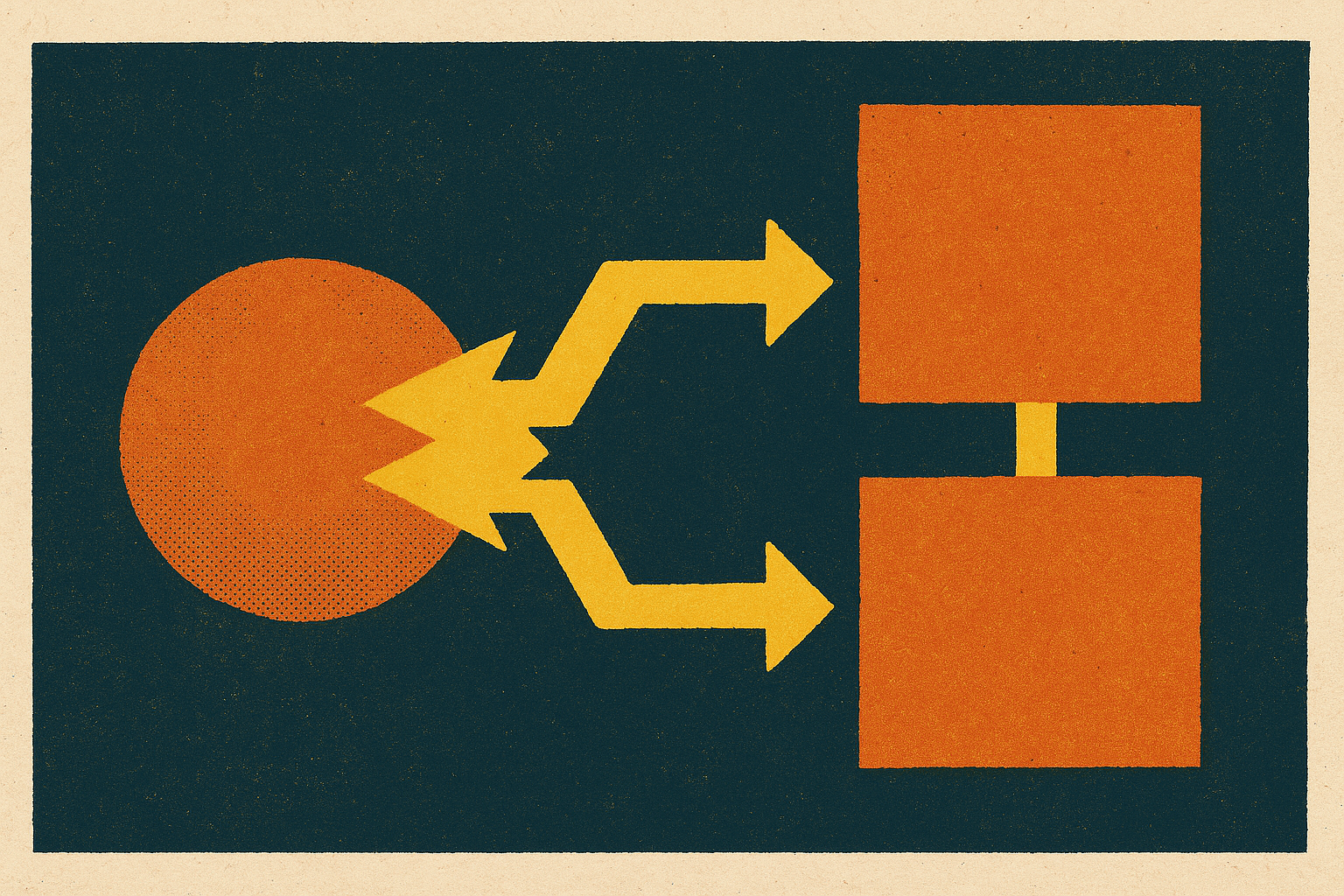
Two systems can send the same order confirmation to the same customer using completely different plumbing. One waits for an answer before moving on, while the other fires off a signal and never looks back. That's the whole ballgame: request-response and event-driven architecture solve the same integration problem, but they start from opposite assumptions about who waits for whom.
The assumptions each pattern bakes into your system design
Request-response is built on three bets: both sides are reachable right now, the caller can't do its next job until it hears back, and if something breaks, it should break loudly and immediately. A client sends a call over HTTP, blocks, and waits, and nothing happens until the answer shows up. That design reflects a deliberate set of priorities: immediacy, certainty, and a clear failure signal. You call your bank to check your balance, you wait on hold, you get a number. Nobody wants the bank to text you back next Tuesday.
Event-driven flips the bet. A producer emits a description of something that happened, a state change, and then walks away, not knowing or caring who's listening or when they act. Consumers subscribe on their own schedule and catch up whenever they catch up. The system tolerates a gap between when something is written and when everyone downstream knows about it. Picture a message in a bottle: you toss it in the water, and it's someone else's problem when it washes ashore.
Here's the part people get wrong constantly: "real-time" in event-driven systems does not mean instant. It means delivered as it happens, which is a different promise. Kafka can move a firehose of events per second, but the latency on any single message is less predictable than a synchronous call that either answers in 200 milliseconds or times out. Higher throughput, weaker latency guarantees. This trade-off doesn't get discussed enough at the whiteboard stage, and it should.
Coupling, resilience, and what happens when a dependency goes down
Request-response fails like dominoes. One database connection drops, and every service that calls it goes down with it. There's no buffer, no shock absorber, just a straight line from the outage to your pager going off. Circuit breakers and retry logic help, sure, but they're patches on top of a design that assumes everyone's available. They don't change the underlying physics.
Event-driven fails like a mailroom with a backlog rather than a phone line with a busy signal. The producer keeps producing, the broker holds the messages, and consumers pick them up whenever they come back online. The upstream service doesn't even know a downstream consumer had a bad day. That's the structural resilience story, and it's the real reason teams reach for message brokers in the first place.
It also changes how you grow a system. Add a new consumer to a request-response API, and you're touching the producer's interface, testing the integration, coordinating a release. Add a new consumer to an event stream, and you just subscribe to the topic, since nobody upstream needs to know you exist. Update an authentication API in a tightly coupled request-response setup and you can break three frontend teams' code in one deploy; that's not hypothetical, that's a Tuesday.
None of this is free, though. The broker becomes the thing you now have to keep alive, monitor, and understand deeply, ordering guarantees and all. Testing also gets harder. A request-response function is simple: input goes in, output comes out, write a unit test, and you're done. An event-driven system asks you to test for eventual consistency, message ordering, timing windows. That's a real skill investment, not a checkbox.
Where each pattern has a natural fit
Request-response wins when the caller genuinely can't move forward without an answer. Authentication, payment authorization, checking if an item's actually in stock, these need a yes or no before the next step makes sense. It also wins when consistency isn't negotiable: financial math, access control, anywhere a stale read turns into a real mistake with real money attached. Frankly, if your system is small, standing up a broker just to say "email sent" is like renting a moving truck to bring home a sandwich.
Event-driven earns its keep when one thing happening needs to trigger a handful of unrelated reactions. An order gets placed, and suddenly inventory updates, fulfillment kicks off, a notification goes out, analytics logs it, all at once, all independently. It's also the right call when the producer shouldn't be held hostage by a slow consumer, think IoT sensors streaming data or clickstream logging, and when you're expecting traffic spikes that need to be absorbed rather than passed straight through to a service that'll fall over.
Financial services and telecom lead adoption of this pattern for good reason: they both need to fan real-time data out to a lot of downstream systems at once. BFSI held the largest share of the event stream processing market in 2024, at 23.8% according to Mordor Intelligence, and telecom is projected to grow fastest, at a 28.9% compound annual rate. That tracks, since a dropped call or a fraud alert doesn't wait for a polling interval.
Most real systems, though, don't pick a side. Look at checkout. The payment step has to be synchronous, since you need a yes or no on that card before you show a confirmation screen. But everything after, the receipt email, the loyalty points, the inventory adjustment, none of that needs to block the customer. Request-response and event-driven sit in the same flow, doing different jobs. A friend of mine who ran platform engineering at a mid-sized retailer once spent a full quarter chasing a checkout slowdown, only to find someone had made the loyalty-points update synchronous with payment processing. Fixing it was a one-line change, though the lesson took him a lot longer to learn than it took to type.
EDA patterns that solve problems request-response cannot
A few patterns exist specifically because event-driven systems open doors that request-response can't reach.
Event sourcing stores every state change as an entry in an ordered log instead of overwriting the current value. Want to know what an account balance looked like six months ago? Replay the log up to that point. Banks use this to reconstruct history rather than trusting a single mutable row that's been overwritten a thousand times. It's usually paired with CQRS (Command Query Responsibility Segregation), which splits your write model from your read model so each can be tuned on its own terms.
That separation isn't just architectural cleanliness, it shows up in the numbers. A 2025 analysis of production CQRS deployments found specialized read models cut storage needs by 51%, with event replay hitting 215,000 events per second and read projections landing within 1.8 seconds of the original write. An e-commerce platform might run one model built for processing new orders fast, and a completely separate one built for someone scrolling through years of order history.
Then there's the saga pattern, which handles distributed transactions without a global lock, something request-response systems handle badly because nobody wants to hold a lock open across five microservices while they all take turns. In the choreography version, services react to each other's events with no conductor. In orchestration, a central coordinator calls each step directly, easier to follow, but now that coordinator is a single point of failure. Either way, when something fails partway through, compensating transactions roll back the earlier steps. It's how "undo" gets built into a system that has no single database transaction to roll back.
Underneath all of it sits the outbox pattern paired with change data capture. Write the event to a local outbox table in the same transaction as the actual business record, then let CDC relay it to the broker. This solves the dual-write problem, the nightmare scenario where your database write succeeds but the message never made it to Kafka, or vice versa. It's not glamorous, but it's the plumbing that makes event sourcing and sagas trustworthy in production instead of theoretical.
Where enterprise adoption actually stands, and what is still hard
The gap between talking about event-driven architecture and actually running it is wide. A 2021 Solace and Coleman Parkes survey of 840 organizations found 85% recognize EDA as critical to their business, yet only 13% said they'd reached full maturity with it. Everybody agrees it matters, but almost nobody's actually finished building it. Ask a room full of architects if EDA is the future, and every hand goes up; ask how many have actually finished the migration, and you can hear crickets.
The same survey points at why. Seventy-five percent cited inadequate technology. Fifty-nine percent hadn't even settled on the right tools and vendors yet. Thirty-seven percent said they simply don't have the talent in-house to pull it off. There's also a quieter gap sitting underneath all of that: 61% of IT professionals get excited about real-time, event-driven data distribution, but that enthusiasm drops to 35% among the business decision-makers who approve the budget. Engineers see the resilience story, while finance sees a line item they don't fully understand.
Even so, the direction is clear. An IDC and Solace survey from 2023, covering more than 300 enterprise IT professionals, found 82% planned to apply EDA to two or three new use cases within the following two years. Among companies that had already deployed it across multiple use cases, 93% said it met or beat their expectations. Gartner's 2024 projection puts it plainly: more than 90% of global enterprises will have adopted some form of EDA as central to their digital platforms by 2026. Read that as validation of hybrid systems, and a sign that request-response is holding its ground rather than fading out.
Market size estimates for EDA platforms bounce around depending on who's counting, landing somewhere between $2.8 billion and $3.7 billion in 2024, with projections stretching anywhere from $9.7 billion to $27.2 billion by 2033. It's a wide range, sure, but every source points the same direction: up, and not slowly.
How to decide: the questions that actually determine the right pattern
Request-response holds its ground as the correct answer for a specific set of needs, and pretending otherwise is how teams end up bolting Kafka onto a contact form. That's using a firehose to water a houseplant.
Four questions actually settle this, and they're worth asking in order. Does the caller need the result before it can do its next job? If yes, request-response; if the action can complete without waiting on downstream confirmation, event-driven opens up. How many consumers care about this event? One consumer in a predictable setup, stick with request-response. Multiple independent consumers who each need to react their own way, that's event-driven fan-out doing what it's built for. What's your acceptable consistency window? Need the current, known state immediately, request-response. Comfortable with the system catching up in a few seconds, event-driven works fine. What failure modes can your system actually absorb? If a downstream outage must not stop the caller, you need the broker's buffer. If a failure should stop everything right there, like a declined payment, synchronous is the right and correct behavior, not a limitation.
Most systems above a certain size end up running both, and that's not indecision, that's just good engineering. User-facing reads and writes stay synchronous because people want answers now. Background jobs, notifications, analytics, audit logs, those move to event-driven because nobody's staring at a spinner waiting for the audit log to update. The line gets drawn at the level of individual service interactions, not across the whole application.
None of this comes free. Event-driven systems need a broker, real observability tooling, schema contracts so producers and consumers don't quietly drift apart, and a team that can reason clearly about eventual consistency without panicking every time two reads disagree for half a second. Skip that investment and the resilience story falls apart the first time something actually breaks.
So start plain: request-response where simplicity and consistency carry the most weight, event-driven layered in selectively where decoupling, fan-out, or resilience are the actual, provable requirement. Treat every seam between the two as a decision someone made on purpose, wrote down, and can explain later, not as an accident of whichever tutorial got followed that week.