Common API Integration Failure Modes and Fixes
Recurring patterns explain most integration failures, and four of them hide entirely.
API uptime dropped from 99.66% to 99.46% between Q1 2024 and Q1 2025, according to Uptrends' State of API Reliability 2025 report. That sounds minor, but weekly downtime jumped from 34 minutes to 55 minutes, a 60% increase in a single year, driven by more microservices, more third-party dependencies, and more places for things to break that no single team controls.
MuleSoft's 2026 Connectivity Benchmark Report surveyed 1,050 IT leaders and found the average enterprise runs 957 applications, with only 27% of them actually connected. Every unconnected app is a failure waiting to happen, and ApyHub's 2026 research puts it plainly: nearly 40% of businesses report ongoing API integration problems.
ITIC's 2024 Hourly Cost of Downtime survey pegs the average cost for a mid-size or large enterprise at more than $300,000 per hour, and 41% of enterprises report hourly losses between $1 million and $5 million. These failures consistently appear in the same handful of patterns across different companies and stacks, and once you identify the pattern, the fix becomes straightforward.
How integration failures follow recurring patterns
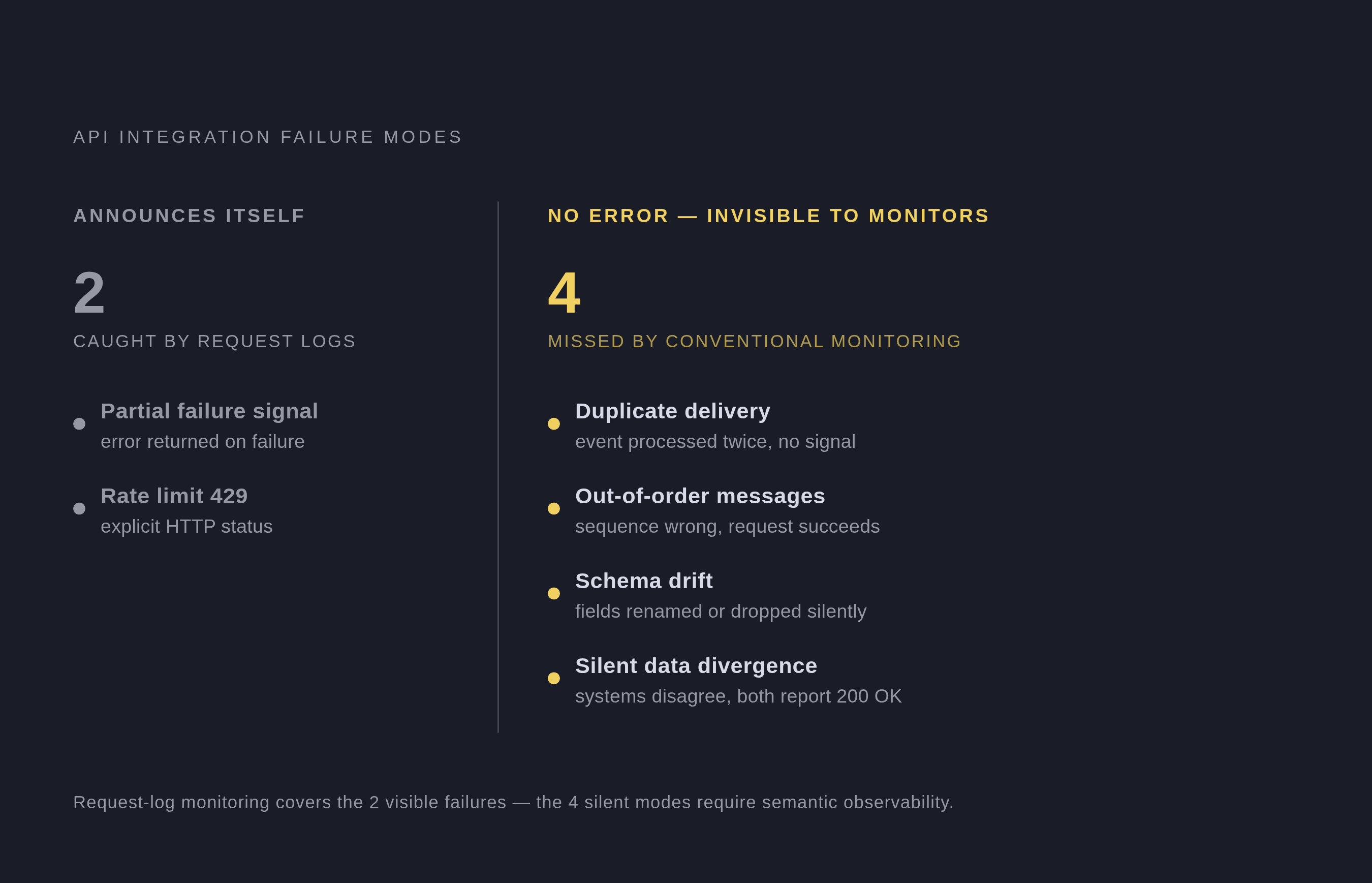
Six failure modes account for almost everything that goes wrong between two systems: partial failure where you cannot confirm the call landed, duplicate delivery from overeager retries, messages arriving out of order, schema drift, rate limiting, and silent data divergence where both systems believe they agree but do not.
Four of those six produce no error at all. No failed request, no 500 in the logs. Just incorrect data sitting in a database, waiting for someone to notice.
That is the central diagnostic problem. Monitoring that only checks whether a request returned successfully covers the two failure modes that announce themselves and ignores the four that do not.
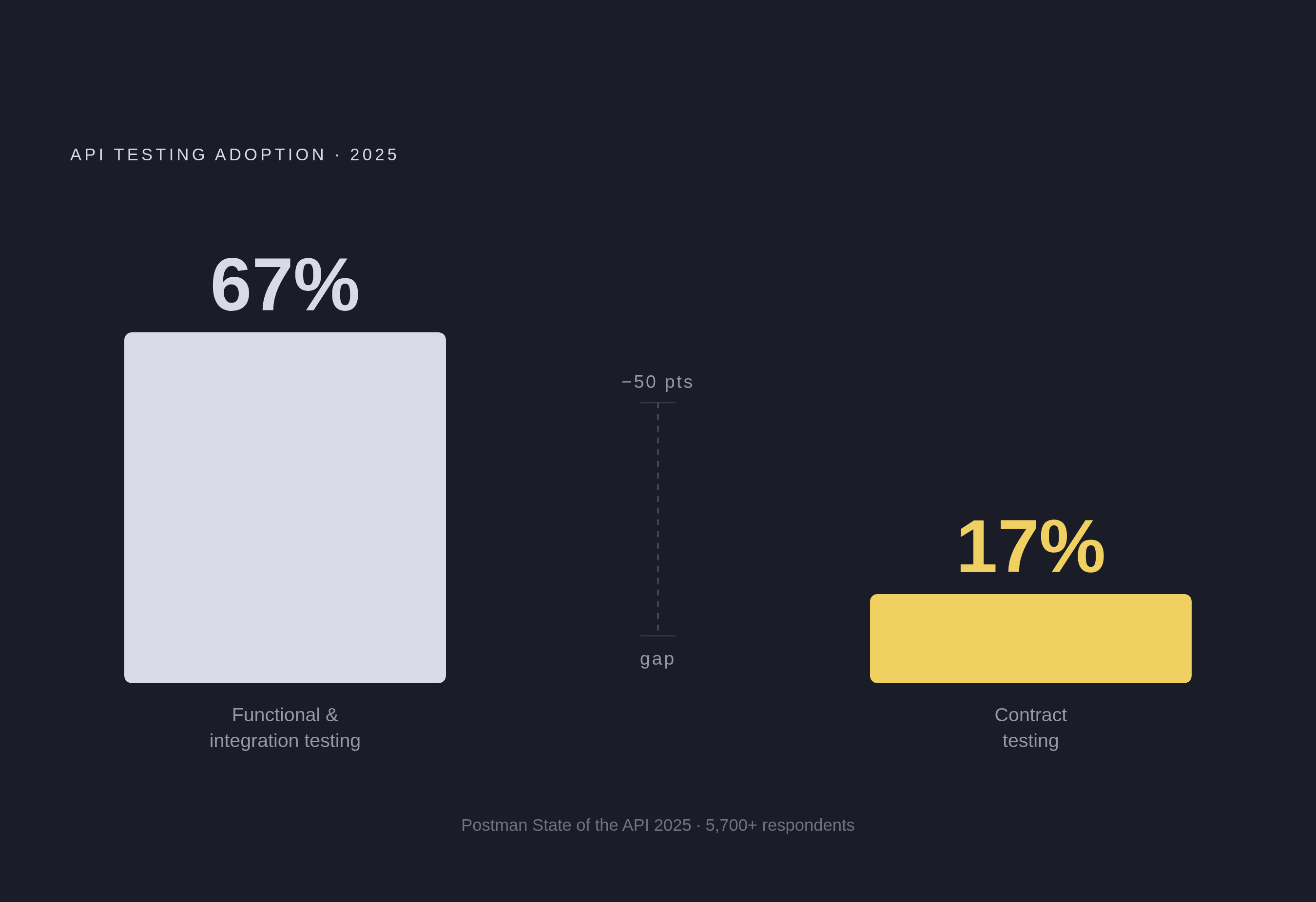
Postman's 2025 State of the API report, based on more than 5,700 respondents, found functional and integration testing adoption at 67%. Contract testing, which verifies that two systems actually agree on what they are sending each other, sits at just 17%. Most teams verify their own output without confirming whether the receiving system interprets it correctly.
Additionally, 93% of API teams report collaboration blockers, and most cluster around documentation that is missing or inaccurate. The gap between what an API is supposed to do and what it actually does often goes unrecorded until it causes a failure.
The rest of this piece covers five of these patterns: authentication breakdowns, rate limit mishandling, timeout cascades, schema drift, and security vulnerabilities inside the integration layer. Each has a root cause and a documented fix.
Why authentication failures go silently unnoticed
Authentication failures surface quietly. A 401 or 403 appears in a log, the expected data never arrives, and the user sees stale information on a dashboard with no indication anything is wrong.
The root cause is almost always the same: OAuth access tokens have short lifespans. Xero expires them after 30 minutes, and QuickBooks Online gives you 60. Any integration that waits for a token to fail before refreshing it will eventually encounter a mid-request failure on whichever sync job holds an expired token.
The OAuth flow itself is not the core problem. The failures live in edge cases that do not get tested:
- A field gets renamed, such as
amount_outstandingbecomingoutstanding_balance, without a version bump, and parsing breaks silently downstream. - Session expiry only manifests in multi-tenant setups, where one token is expected to cover many accounts and quietly stops covering all of them.
- On large accounts with over 1,000 records, a sync cursor can expire mid-run and return a partial dataset with no error thrown.
The fix is proactive refresh: renew the token before it expires rather than waiting for a 401 to trigger a refresh-and-retry sequence. Two supporting practices worth building in alongside this: short-lived credentials with automatic rotation, and least-privilege scope assignment, so a compromised token cannot cause significant damage even if it is exposed. Accounting APIs like FreshBooks, Xero, and QuickBooks make useful case studies here because their token lifespans are public and short enough to force the issue into the open.
What teams get wrong after a 429
HTTP 429, Too Many Requests, is one of the most disruptive errors integrations encounter at scale. Workday, ADP, Salesforce, QuickBooks: all of them enforce limits, and all of them expect your code to handle it.
The instinct most engineers have when a 429 arrives is to retry immediately. That response is counterproductive: continuing to send requests to an API that just signaled it is overloaded can extend a temporary limit into a longer outage, and in some cases triggers a secondary restriction that is harder to recover from.
Several issues typically underlie naive retry behavior:
- The rate limits configured on your end do not reflect the actual limits enforced by the API.
- The
Retry-Afterheader goes unread, even when the API specifies exactly how long to wait. - There is no real-time alerting, so teams learn they were throttled by reading logs after the fact.
- Usage limits are not documented internally, so multiple services independently consume the same shared quota without awareness of each other.
The standard fix is exponential backoff with jitter. After a 429, wait briefly before retrying, double that wait on each subsequent failure, and add a small random offset so that multiple clients recovering from the same event do not all retry simultaneously and cause a second spike. Honor Retry-After when it is present, because the server is providing the exact recovery window.
The more mature fix is dynamic limiting: monitoring the server's own signals and reducing request volume before hitting a limit. Reduce request volume when CPU crosses 80%, lower it when error rates pass 5%, and adjust concurrency when response latency crosses 500ms. Teams that implement this stop reacting to 429s and start preventing them.
How slow APIs cascade into full outages
A downed API fails immediately and gives you a clear error to handle. A slow API ties up threads, drains connection pools, and backs up queues while every caller waits for a response that may never come.
Akamai's 2024 research found that a 100 millisecond delay in load time can reduce conversion rates by 7%. That level of latency is invisible in most test environments but produces measurable revenue loss in production.
Four of the six silent failure modes mentioned earlier return a 200 status code while delivering incorrect or incomplete data. A 200 indicates success to most monitoring setups, while the actual response content may be wrong.
Retries handled poorly make this worse. Unbounded retries convert one slow API into a retry storm across every caller simultaneously. A reasonable default is 3 retries for most cases, with 5 as the recommended maximum for flows requiring high reliability, per docs.commercetools.com's error handling guidance. Without a ceiling and proper backoff, retries become a contributing cause of the outage rather than a recovery mechanism.
The fix is exponential backoff with jitter, triggered by timeout signals rather than rate limit responses. Progressive wait times give the struggling service room to recover, and jitter prevents clients from retrying in lockstep. A circuit breaker is the second fix: when a downstream service is clearly failing, stop calling it, protect your own resources, and poll for recovery on a schedule rather than continuously retrying a non-responsive endpoint. On the monitoring side, validate that data is consistent across systems rather than only confirming that requests returned a response. Request-level logging alone will not surface silent failures.
Why schema drift catches 52% of teams off guard
According to the State of the API report, 52% of developers encountered a production crash in 2024 because a third-party vendor pushed a breaking change without warning.
Contract testing adoption at 17% is the primary reason this keeps happening. Most teams verify that their own code behaves correctly but never verify that the agreement between their system and the vendor's system still holds. Schema drift therefore gets discovered in production, after the damage is done.
Staging environments compound the problem. Most staging setups run with a small number of records, while production accounts carry thousands. Pagination bugs and field-level edge cases that never appear in a ten-row test dataset surface immediately at scale. API versioning, which should be treated as a formal external commitment, often gets handled as an internal engineering decision until it produces a visible integration failure.
To make the stakes concrete: an invoice syncs with tax_amount: 0 because a field was renamed upstream. No error is thrown. The record passes reconciliation with incorrect numbers, and the problem goes undetected until month-end close, by which point the data has already informed downstream decisions.
Common sources of breaking changes include: removing fields, changing response formats, moving endpoint paths, and changing a data type without incrementing the version number.
Three fixes, in order of leverage:
- Contract testing. Consumer-driven contract tests running in CI verify the agreement between producer and consumer before anything ships. Raising the industry's 17% adoption rate is the highest-return testing investment available in this area.
- Deprecation governance. Announce changes in advance, publish a migration guide alongside the announcement, and give consuming teams sufficient runway before removing legacy support.
- Field-level monitoring. Alert immediately when a previously populated field returns null or changes type, rather than waiting for a downstream system or user to surface the discrepancy.
Security vulnerabilities inside the integration layer
Research consistently shows API security incidents are widespread across organizations of every size.
The most dangerous single vulnerability is Broken Object Level Authorization, or BOLA, which sits at the top of the OWASP API Security Top 10. BOLA occurs when a server verifies identity at login but does not check on subsequent requests whether the authenticated user is authorized to access a specific object. Authorization is confirmed once and then assumed on every request that follows.
Detection is difficult because a large share of API attacks originate from authenticated users. Traffic-volume anomaly detection misses most of this activity because the attacker is not sending more requests than normal. They are requesting objects they should not have access to within a session that looks legitimate.
The integration layer requires specific attention, separate from perimeter security, for several reasons:
- Every integration point is its own trust boundary and requires its own authorization checks, rather than relying on a shared assumption that perimeter controls are sufficient.
- Scope creep in OAuth grants is a common attack vector. The least-privilege principle from the authentication section applies here directly.
- A third-party integration inherits the security posture of whatever it connects to. A compromised vendor API can exfiltrate data through a connection that appears secure on your end.
The practical fix is to apply the OWASP API Top 10 as a checklist against every integration: enforce object-level authorization on every request rather than only at login, audit OAuth scopes on a regular schedule and remove anything beyond the minimum required, and monitor for behavioral anomalies inside authenticated sessions rather than only watching for spikes in raw traffic volume.
A diagnostic sequence to run before deployment
Five failure modes, five checkpoints. Run these before deployment, not after the postmortem.
Authentication. Is token refresh proactive, or does the system wait for a 401 before acting? Are scopes as narrow as they can be? Have multi-tenant setups and large-account syncs been tested, or only assumed to work?
Rate limiting. Is backoff with jitter implemented? Are CPU, error rate, and latency wired up to adjust throttling automatically? Is the Retry-After header being read and honored?
Timeouts. Is there a hard retry ceiling of 3 to 5 attempts? Is a circuit breaker in place? Does monitoring validate data consistency across systems, or only confirm that requests returned a response?
Schema drift. Are contract tests running in CI? Is field-level monitoring watching for nulls and type changes? Is there a documented policy for deprecating and communicating changes?
Security. Is object-level authorization checked on every request? Are OAuth scopes audited on a schedule? Is anyone monitoring for behavioral anomalies inside sessions that are already authenticated?
Four of the six most common failure modes produce no error, which means a diagnostic built only around request logs will miss most of what is actually going wrong. Data-level validation across system boundaries is necessary to catch failures that do not surface through standard error reporting.
The 17% contract testing adoption figure is worth noting specifically because raising it does not require new tooling or an unfamiliar testing category. It is a well-understood practice that closes the largest gap between staging behavior and production failures.
These failures repeat across different teams, stacks, and vendors in the same recurring patterns, which is why the fixes are portable. Catching them before deployment costs a fraction of what it costs to diagnose them after a customer has already been affected.