API Integration Maintenance Costs Over Time
Maintenance costs balloon quickly and often catch teams off guard.
API integration costs don't stop at the invoice for the build. That's the entry fee. The real cost shows up every year after, in engineering hours nobody budgeted for, in outages caused by deprecated endpoints nobody updated, in security gaps left open by integrations nobody tracked. Most teams still price a subscription as if it were a one-time purchase, then absorb the shock when the annual maintenance bill arrives, unannounced and unbudgeted. This post breaks down exactly where those costs come from, how they compound across a multi-year integration lifespan, and what teams can do to stop treating a predictable operating expense as a surprise.
What building an integration actually costs upfront
The price tag for building an integration ranges wildly, and that range reflects real variation in scope. A simple connection between two systems might start around $2,000. A complex enterprise system can blow past $100,000. Most integrations land in the middle: $15,000 to $40,000 for a mid-complexity build.
Take an HRIS integration. Done properly, with real authentication, error handling, and data mapping, that's 4 to 8 weeks of senior engineering time, fully loaded somewhere between $25,000 and $65,000. At the enterprise tier, building in-house commonly takes 12 to 18 months.
Here's what none of those numbers include: the operational scaffold that keeps the thing alive after launch. Monitoring, error handling, schema tracking, version compliance. Build cost is a one-time capital expense, paid once and closed out. Maintenance is an operating expense that starts the moment the integration goes live and never flattens out. It just keeps going, like a gym membership you can't cancel because the gym is also your production environment. Anyone still pricing an integration as a single line item on a project plan is underestimating what it will actually cost.
How maintenance costs compound year over year
The common rule of thumb puts annual maintenance at 10% to 20% of build cost. Some practitioners budget 15% to 25%, treating it as the true cost of ownership rather than a support line you skip when the quarter's tight. Skip it, and the bill doesn't disappear. It just gets billed later, as an outage.
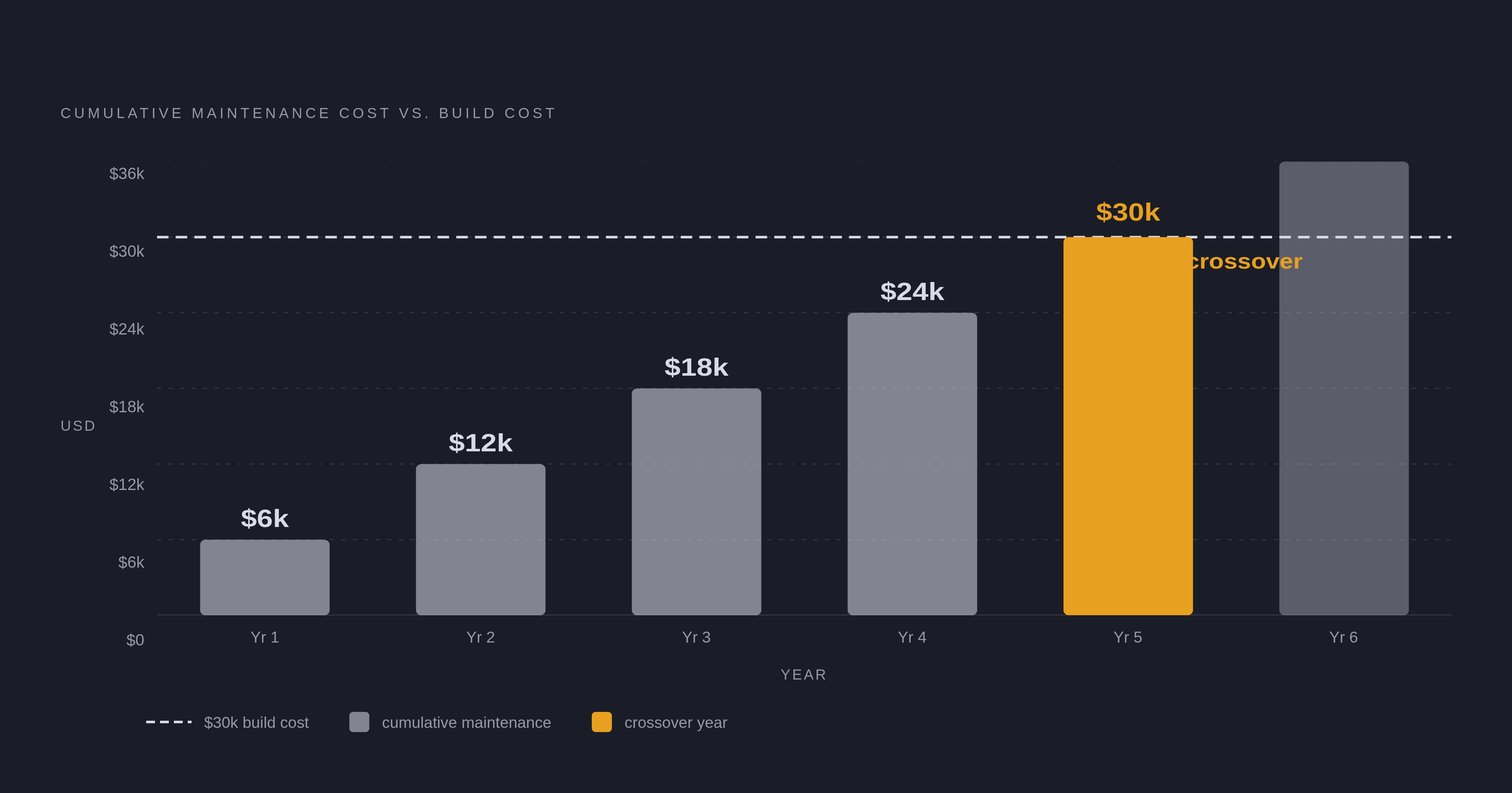
Run the math on a mid-range build. A $30,000 integration at 20% annual maintenance costs $6,000 a year. Fine in year one, barely worth mentioning. But by year four, cumulative maintenance has caught up to the original build cost. The integration got paid for twice, just spread out enough that nobody noticed. At the enterprise tier, where annual maintenance runs $200,000 to $500,000 and requires two to three dedicated engineers, the same math just carries more zeros.
E-commerce shows how lopsided this gets fast. Building integrations across three platforms typically runs $15,000 to $30,000. Ongoing support for that same setup can reach $90,000 a year, which means the maintenance tail can hit three to six times the build cost inside a single year. Maintenance is exposed to the same labor cost inflation hitting engineering everywhere, plus a set of escalators specific to integrations, covered next.
Versioning and deprecation drain engineering time constantly
Baseline maintenance runs 1 to 2 weeks of engineering time per year, per active integration, just to keep pace as vendors update schemas and ship new versions. That's before anything actually breaks. Versioning and connector updates alone eat up roughly a quarter of total engineering maintenance time, spent keeping up with changes nobody on the integration team asked for.
Deprecation follows a pattern familiar to anyone who's lived through one. Vendors announce end-of-life six to twelve months out. The deadline arrives, and the platform extends it. The old version lingers past its supposed death date, teams breathe easy, and everyone quietly deprioritizes the migration. Then, without much warning, the real cutoff hits, and what should've been a planned migration turns into an emergency one. Supporting several versions at once in the meantime adds its own tax: a transformation layer for each version, test coverage across every combination of versions the integration might touch.
The failure underneath all of this is a planning failure, not a technical one. Most teams design for compatibility on launch day, not for version two, three, or four the vendor ships 18 months later. Vendors will always ship new versions, and that part is entirely predictable. What isn't predictable is whether a given team treats it as a scheduled cost or a fire drill. Bet on the fire drill. That's what most teams choose, whether they mean to or not.
API sprawl makes the maintenance problem uncontrollable
Some enterprises manage 354 or more distinct APIs, each with its own routing, authentication, rate limiting, versioning, and monitoring needs. That's 354 separate small maintenance burdens, running at once, aging at different rates, each waiting its turn to break.
It gets worse before it gets better, because most organizations don't know what they're maintaining in the first place. Active API counts routinely run 10% to 20% higher than what IT actually has on record, which means the maintenance budget gets built on an incomplete inventory and is wrong before the year even starts.
Sprawl compounds through plain duplication. A developer needs a capability, can't find it already exists somewhere else in the org, and builds it again. Now two APIs do the same job. Both carry infrastructure costs, both carry gateway fees, both need maintaining through every future deprecation cycle. Money spent twice for one outcome, forever.
Stretch that pattern across three to five years, and the result is a pile of inconsistently designed, half-documented integrations, each solving a slightly different version of the same problem. Every new integration added to a sprawling portfolio adds the coordination overhead of everything it now touches, which is a much bigger number than one, and nobody's tracking that multiplier at design time.
Poor maintenance discipline causes expensive downtime
The reliability picture is getting worse, not better. Global API downtime rose 60% in Q1 2025 compared to Q1 2024, according to the State of API Reliability 2025 report. Average weekly downtime climbed from 34 minutes to 55 minutes over that stretch, an extra 90 minutes of downtime every month, month after month, compounding.
Third parties are doing most of the damage now. Outages caused by third-party dependencies jumped from 24% of incidents in 2024 to 63% in 2026, according to Splunk's downtime cost reporting. The integration a team stopped watching closely is very often the one that takes the whole system down. Cause and effect, with a delay built in.
Downtime is not cheap, either. ITIC's 2024 Survey found 90% of mid-size and large enterprises report that one hour of downtime costs over $300,000, and 44% report it can top $1 million. For Fortune 500 companies, an hour can run past $5 million. Run the SLA math on a "solid" 99.9% uptime guarantee: that's still roughly 8.7 hours of potential downtime a year. At those incident costs, that exposure is a budget line hiding in plain sight.
None of this happens in a vacuum. Incidents at this scale are usually the deferred bill for skipped version updates, unmonitored deprecated endpoints, and an API inventory nobody tracked. The slow failures from earlier sections don't go away. They wait, then show up all at once as acute ones.
Security maintenance is permanent, not a launch checkbox
The evidence is consistent: most organizations encounter API security problems, yet governance strategies capable of handling them remain far from universal. That gap between how widely organizations get hit and how few have a real plan says most organizations are treating security maintenance as optional.
The cost of getting this wrong isn't small. The cost of getting this wrong isn't small, and the numbers behind every skipped security audit, every deferred token rotation, and every access control nobody got around to reviewing are larger than most teams budget for.
Security maintenance calls for continual review, not a one-time sign-off at launch. Every integration added to the portfolio widens the attack surface a little more. Authentication schemes, token management, access controls all need ongoing attention. The sprawl problem makes this worse directly, because an undiscovered API is an unpatched API. Nobody audits the thing they don't know exists.
Security maintenance is a when, not an if. Yet this spend usually sits buried inside general IT security budgets, invisible to the teams that own the integrations, invisible to whatever cost model got built when the project first launched.
Maintenance drains the roadmap nobody can see
Maintenance line items understate the real cost, because they only count what got spent, not what got skipped. Every sprint burned keeping an old integration alive is a sprint that didn't go toward a new feature, a new revenue stream, or whatever the competition just shipped. For product-led companies, especially in HR Tech and SaaS, this is often the biggest hidden cost of all: the roadmap that never got built, the deal that never closed because the feature wasn't ready in time.
Zoom out and the waste gets genuinely staggering. Duplicate data from sprawl costs American businesses roughly $600 billion a year, by one estimate from Boomi's analysis. That's the macro version of the same story playing out at the level of a single engineering team's sprint planning, just with nine more zeros attached.
Opportunity cost never shows up on an invoice, so it never makes it into the ROI math done at launch. A team that counts build cost and the annual maintenance percentage but skips opportunity cost is still underestimating the total price, often by a wide margin. Maintenance-heavy integration portfolios slow the organizations carrying them down, a cost that's much harder to see and much easier to ignore than a line item in a budget.
How to reduce long-term maintenance accumulation
Start with an honest inventory. If active API counts run 10% to 20% higher than anyone's aware of, the first real cost reduction is simply counting correctly, using discovery tooling and a governed API catalog that someone actually keeps up to date. Skip this step and every other fix on this list gets built on bad data.
Versioning discipline heads off the worst of the deprecation spike. Set internal deprecation policies with real timelines, mirroring the six-to-twelve-month notice vendors already give, and migration becomes a planned project instead of an emergency. Teams that plan retirement at the same time they plan launch don't end up watching a six-month migration balloon into an eighteen-month fire drill.
The build-versus-buy math changes once maintenance gets counted properly, and this is where most teams get it backwards: they price the build and ignore the tail. A managed integration platform that handles connector updates, version compatibility, and monitoring takes that 1 to 2 weeks of annual per-integration maintenance off internal engineering's plate and hands it to the vendor instead. Multiply that across a few hundred integrations and it stops being a nice-to-have.
Treat maintenance as a scheduled budget line, not a contingency fund. Annual maintenance at 15% to 25% of build cost, security audit cycles, a reserve for version migrations: none of this is unpredictable. Teams that underpay for integrations are, almost without exception, the teams that left these line items out of the original model. Monitoring and observability tools pay for themselves here too; catching a broken endpoint before it causes an outage costs far less than the outage itself, and closing the gap between 99.66% and 99.46% uptime saves 90 minutes of exposure every month.
Maintenance costs compound when nobody's watching them. They get manageable the moment they're measured, scheduled, and assigned an owner, the same way build costs already are. Treat it as anything less than that, and the invoice just shows up later, bigger, and with interest.