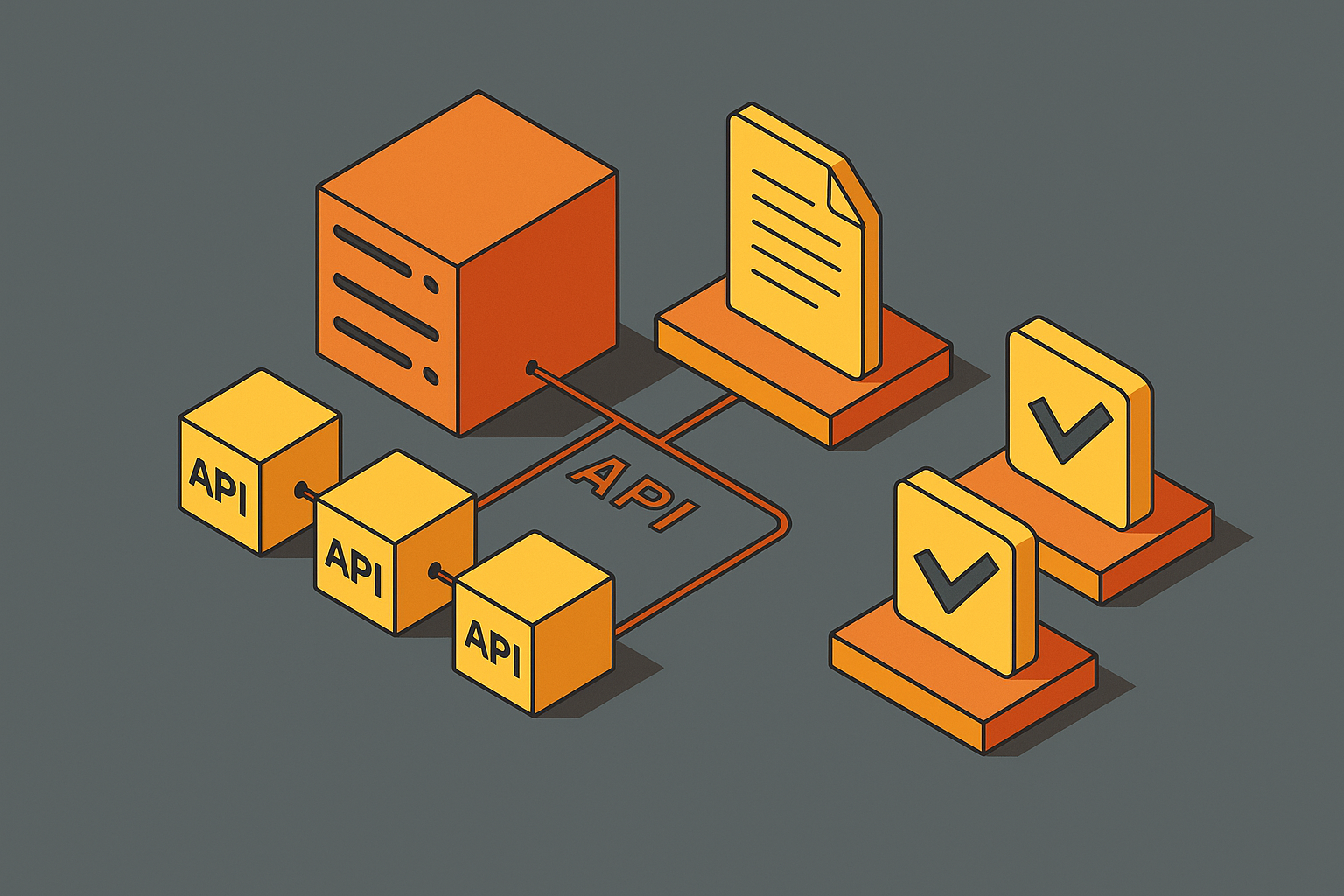
API Integration Software Evaluation Criteria
Evaluate platforms by architecture first, then technical breadth, governance, and cost.
Teams rarely fail at API integration because they skip a criterion. They fail because they grab the right criteria in the wrong order, and the platform they end up with gets optimized for a problem they didn't actually have. Enterprise API integration has gotten genuinely complicated: large organizations now run dozens to hundreds of applications across cloud, SaaS, on-premises, and hybrid environments, and every layer of that stack adds governance, security, and data-architecture decisions that all lean on each other. One decision made out of order doesn't just cause a small headache later. It can quietly reshape every decision made after it.
Teams start by comparing connector counts or pricing tiers, which are late-stage questions, before they've settled on an architecture category or nailed down governance requirements, and that pattern keeps repeating. The cupholders might be great.
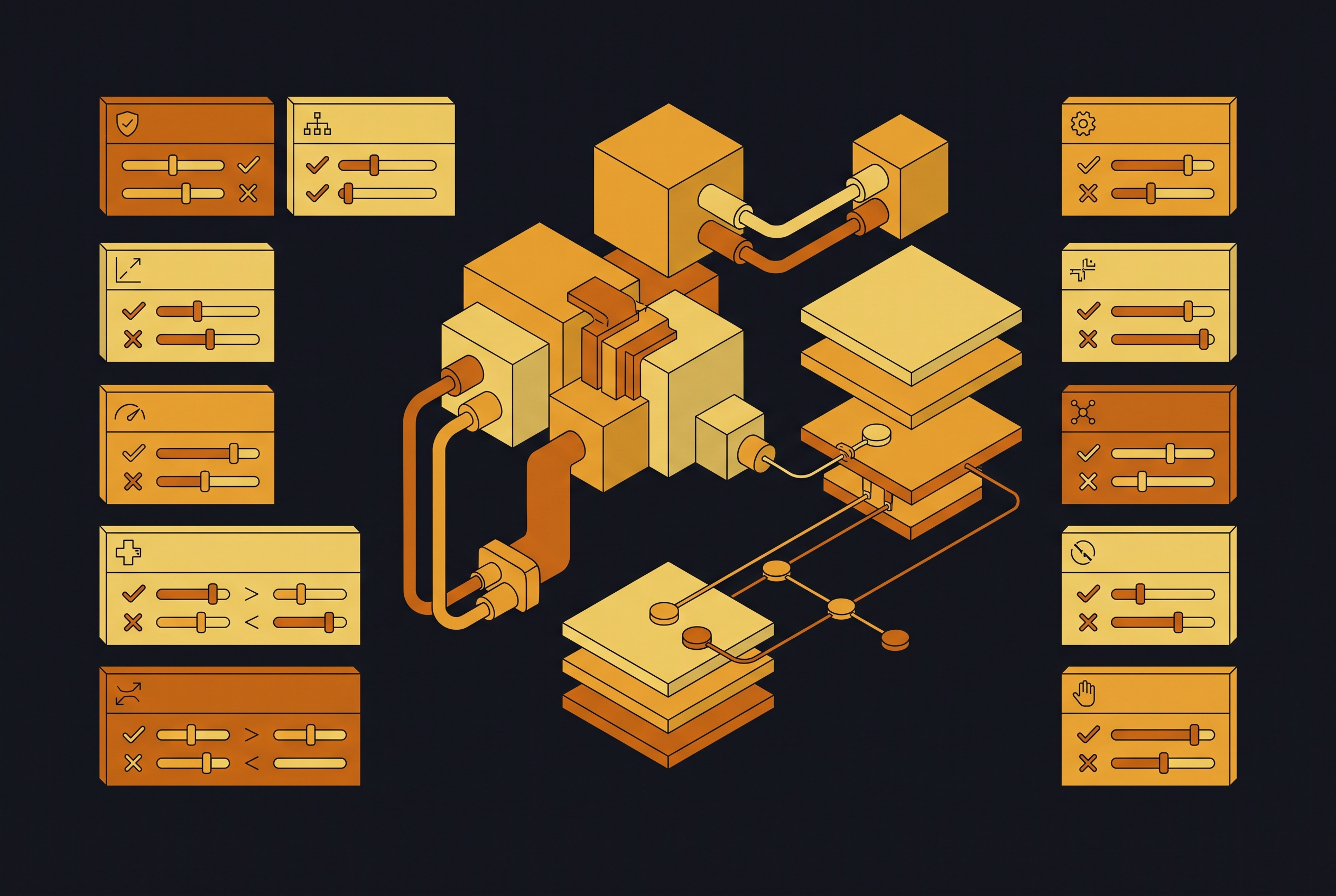
Architecture category gets decided first, then technical breadth, then governance, then scalability, then total cost. Each layer gates the next one, so if you skip ahead, every downstream answer gets built on an undefined foundation. Working through the layers in order is the evaluation skill itself, not a formality wrapped around it.
What API integration services cover
Before any of that sequencing can happen, the category itself needs to be nailed down, because mixing up API integration services with API management or iPaaS is its own evaluation error, one that happens before the framework even starts. Each of these categories answers a different question, and each carries a different set of selection criteria, so applying the wrong rubric to the wrong category guarantees a mismatch no matter how carefully the rest of the process goes.
API integration services cover the creation, implementation, management, and ongoing optimization of integrations across cloud-native platforms, legacy systems, third-party services, databases, AI models, and core business processes. That's a lot more than wiring two apps together. API management, on the other hand, covers the secure handling, control, publishing, and monitoring of APIs through gateways, a distinct job with a distinct toolset. And a unified API platform (names like Unified.to, Merge, Nango, Apideck, and Kombo show up here) normalizes a whole category of third-party APIs behind one interface. It is not a gateway, not an iPaaS, not a workflow-automation tool, even though it gets lumped in with all three in casual conversation.
iPaaS platforms and workflow-automation tools (Boomi, Workato, Zapier among them) solve a different problem entirely: SaaS-to-SaaS connectivity. That's not the same problem a unified API solves, and it's not the same problem a full integration services partner solves either. Picture a retailer trying to connect an ecommerce platform, an inventory system, several logistics partners, payment systems, and an AI recommendation model. That retailer needs integration services, not a gateway with a nice dashboard. Getting the category right at the outset is what keeps every later layer of evaluation pointed at the right target.
Architecture category is the first and most consequential decision, because it determines everything downstream
With the category sorted, the first real decision is architecture, and it's the one that carries the most weight because it sets the terms for everything that follows. A platform either reads live from the source (pass-through) or syncs data into its own store and serves up a copy (sync-and-store). That one choice decides data freshness, breach exposure, audit scope, and how cost scales as volume grows. Nothing downstream can be fairly compared until this is settled.
First-generation unified API platforms, Merge and Kombo among them, use one shared data model, but they serve reads from the vendor's own database. On Kombo specifically, custom-field values get collected during a sync rather than pulled live, though field discovery can happen in real time through Kombo's Custom Field Explorer. That's a meaningful nuance: discovery is live, but the data itself is only as current as the last sync. A pass-through unified API works differently. It reads straight from the source live, and no customer records sit at rest in the vendor's infrastructure.
That distinction isn't academic. In a sync-and-store model, every integration is a data pipeline someone has to build, sync, and maintain, so each new integration adds to a growing maintenance pile. Reads are only as fresh as the last sync ran, and customer data sits parked in the vendor's infrastructure, which is its own kind of exposure. Deployment topology compounds the question further: architectures need to support multi-cloud, hybrid cloud, and on-premises data centers with high availability, so a pass-through cloud-native platform might be a poor fit for an organization with strict on-premises data residency rules. Get this layer wrong, and no amount of connector breadth or clever pricing fixes it later.
Technical breadth, connector coverage, protocol support, and event-driven readiness, is the second layer, evaluated only after architecture is fixed
Once architecture is locked in, technical breadth is the next fair question to ask, but connector count (the number most vendors lead with) is close to a vanity metric. It tells you how many boxes get checked, not how well any of them actually work. Three questions matter far more: is the data normalization solid, what's the maintenance model, and what's the compliance baseline. Those three decide the real total cost of ownership, but connector count mostly just decides how good the marketing slide looks.
Normalization quality beats raw count because integrations fail predictably, the moment a vendor renames a field, ships a breaking API version, or throttles calls without warning. That maintenance load eats sprint capacity that should be going toward the product roadmap, not toward re-plumbing something that broke over the weekend. A hundred brittle connectors are a hundred ways to get paged at 2 a.m.
None of this means breadth is worthless. Platforms like Merge, with per-linked-account pricing, and Airbyte, with credit-based volume pricing, make connector breadth a genuine differentiator for product-facing integrations. But differentiation in this sector increasingly comes from developer experience, the strength of a partner ecosystem, the quality of managed services, and vertical-specific accelerators built for particular industries. Breadth, by itself, is often a stand-in for qualities that actually matter more.
Event-driven readiness belongs in this layer too, and it's not optional anymore. Integration traffic is shifting away from synchronous request-response patterns toward events, streams, and asynchronous models. Platforms entering 2026 increasingly ship AI gateway capabilities so they can govern how AI agents and large language models access enterprise APIs, and those agents run on event-driven, asynchronous patterns. If a platform can't handle event-driven workflows, it's already behind for AI-enabled work. The technical breadth checklist, properly drawn, includes native support for real-time asynchronous triggers and large-scale batch transfers across mixed environments, plus flexible SDKs for connecting older, custom legacy systems.
Governance and security are now baseline requirements, not differentiators, and evaluating them as optional add-ons is how compliance gaps appear
Governance and security used to count as premium features, things you compared only once connectors, pricing, and dashboards were settled. That approach is how organizations end up discovering compliance gaps after a platform is already live, which is the worst possible time to discover one. Governance now needs a centralized control tower that handles key management, rate limiting, version control, and lifecycle policy enforcement covering the full API lifecycle in one place.
Gartner lays out four capabilities as mandatory, not optional: an API gateway for runtime enforcement, a developer portal for self-service discovery, policy management for rate limiting and OAuth/JWT authentication, and lifecycle governance for versioning and access control. Organizations are increasingly treating APIs as reusable business assets in their own right, so lifecycle management, developer portals, version control, observability, and security governance need to be in place from the start. Security certifications serve as threshold criteria here. SOC 2, GDPR, and HIPAA compliance should be confirmed before a platform even enters detailed evaluation, not weighed against feature lists as if they were optional extras competing for points.
The reason this layer feels more urgent in 2026 specifically comes down to MCP. Gartner's 2026 market definition explicitly includes "providing context, tools, and resources to generative and agentic AI programs" as a core API management use case, which puts AI and MCP readiness on the same footing as any other first-class evaluation criterion. Tyk and Gravitee already ship native MCP gateway support, so if you're building AI workflows, you need to check whether your platform can govern MCP server access, or whether a governance hole sits right under that layer. The EU AI Act adds its own pressure on top of that: it mandates compliance for high-risk AI systems classified under Article 6 and Annex III, requiring data governance, logging, human oversight, and cybersecurity resilience as explicit controls. Analysts argue those requirements extend to AI agents and MCP-facilitated workflows in high-risk contexts, so this layer keeps moving even after you choose a platform.
Scalability and the low-code trade-off: what democratized integration costs you at the point where requirements grow
Low-code and no-code platforms get teams moving fast. But the scalability and lock-in risks baked into that speed are structural, built into the architecture itself, not a cosmetic concern that shows up in a footnote. Those risks become visible right after deployment, exactly when migrating away costs the most.
Scalability evaluation at this layer needs to check whether the architecture supports multi-cloud, hybrid cloud, and on-premises deployment with high availability, and whether both cloud-based and on-premises models can be evaluated side by side to match enterprise needs around control and compliance. The lock-in mechanism in low-code platforms is architectural. Applications built on proprietary platforms often can't access their own underlying source code, so migrating to another platform, or to a code-first approach, gets difficult and expensive. That can limit flexibility down the road, slow migration efforts to a crawl, and risk losing integration logic that took real time to build. A meaningful share of organizations building on low-code platforms worry their applications won't scale as business requirements grow, and a comparable share worry specifically about vendor lock-in.
The clearest version of this failure is what practitioners call the 80% problem. Even on the best no-code platforms, the moment a custom API endpoint shows up that doesn't fit the template, teams get stuck, or they build a workaround more fragile than if they'd just written the integration from scratch. Use no-code for front-end workflows and internal tools, and use low-code for backend logic, scalability, and complex integrations. That line needs to get drawn before platform selection, not discovered the hard way after. Open-source options like Activepieces sidestep the lock-in concern directly by letting you self-host, which removes vendor dependency if your main scalability risk is really about vendor pricing or a sudden change in product direction.
Total cost of ownership is the fifth layer, and published pricing is only the smallest part of it
Pricing comes last in this framework for a reason: it can't be read correctly until the first four layers are settled. A price tag means something different depending on the architecture behind it, the maintenance burden it carries, and the compliance work it does or doesn't cover. Teams that lead with pricing are comparing the most visible fraction of the cost while ignoring the parts that actually grow over time.
Custom integration work makes the pattern obvious. The initial build is usually only a minority of the total cost over a two-year span. The rest lives in maintenance and breakage, because third-party APIs change without asking permission. A field gets renamed, a response format shifts, or an endpoint gets deprecated, and the integration quietly stops syncing until someone notices the data looks wrong. That risk is the default behavior of third-party APIs over any meaningful timeframe.
Hidden costs appear across nearly every platform category in similar ways: premium connector surcharges, charges for development and staging environments, and data engineering and cleaning work during initial setup can each eat up a real chunk of total project cost that the list price leaves out. A fair TCO evaluation weighs upfront licensing fees against ongoing infrastructure costs, connector add-on fees, and the maintenance resources a team will need to keep the lights on. Pricing models vary enough that the unit of comparison has to be specified before any comparison means anything: a per-API-call model is cheap at low volume and expensive at high volume, while a per-linked-account model runs exactly the other way around. The same three questions from the technical breadth layer apply here again, as a final checkpoint rather than an opening filter: confirmed data normalization, the maintenance model, and the compliance baseline. Those three decide real total cost of ownership. Connector count still doesn't.
Applying the layered framework: how platform choice changes when each criterion is evaluated in order
The payoff of working through criteria in order is a reasoning process that holds up under scrutiny, one that different organizations can run through the same five layers and land on different, equally correct answers. That's the whole point: the framework is portable, the recommendation isn't.
Take an enterprise running hybrid on-premises and cloud environments, with strict regulatory requirements like HIPAA and GDPR, and a tangle of legacy systems to connect. Architecture resolves to full iPaaS with an on-premises deployment option. You confirm governance as a threshold requirement before you even look at technical breadth. TCO has to account for per-seat or enterprise licensing costs, not usage-based pricing. MuleSoft Anypoint fits this profile with comprehensive API lifecycle management and governance controls, and Boomi fits it with strong cloud-to-on-premise connectivity and master data management.
A B2B SaaS product team needing customer-facing integrations across CRM, HRIS, and accounting categories, with data that has to be current, resolves to a pass-through unified API instead. Data residency and breach exposure become the primary security criteria, because no customer data sits parked anywhere. You should compare TCO on a per-API-call basis here. If you're a B2B SaaS team that needs current customer data across 33 categories without a third-party copy sitting in the middle, Unified.to fits your case well, because every call reads and writes live against the source.
A team that wants to own its integration abstraction layer and avoid lock-in at the unification level resolves to a code-first, self-owned model. Nango suits that profile, with synced records cached on Nango Cloud (AWS, US) and payloads pruned 30 days after their last update. An HR-only product needing a vendor-hosted copy of HR, payroll, recruiting, assessment, and learning data points toward Kombo, which covers that exact range and mirrors data into its own store, priced per connected customer. And a team doing data integration and pipeline API generation with compliance certifications as a hard requirement points toward Integrate.io, which delivers automated REST API creation with SOC 2, GDPR, and HIPAA compliance, over 200 prebuilt connectors, and a fixed-fee unlimited pricing model.
The build-versus-outsource decision runs through the same five layers. Architecture category, technical breadth, governance, scalability, and TCO all apply equally to the question of whether to staff integration expertise in-house or bring in a services partner. Choosing the right partner requires the same clarity the rest of this piece has been building toward: it means knowing what sets an API integration provider, an API management vendor, and an iPaaS platform apart. The same category confusion that derails platform selection can derail partner selection just as easily. The platforms named here will change. The five-layer sequence they get run through won't.