Webhook Versus API for Real-Time Data Delivery
Webhooks push data to you; APIs make you pull it—choose based on who should control the timing.
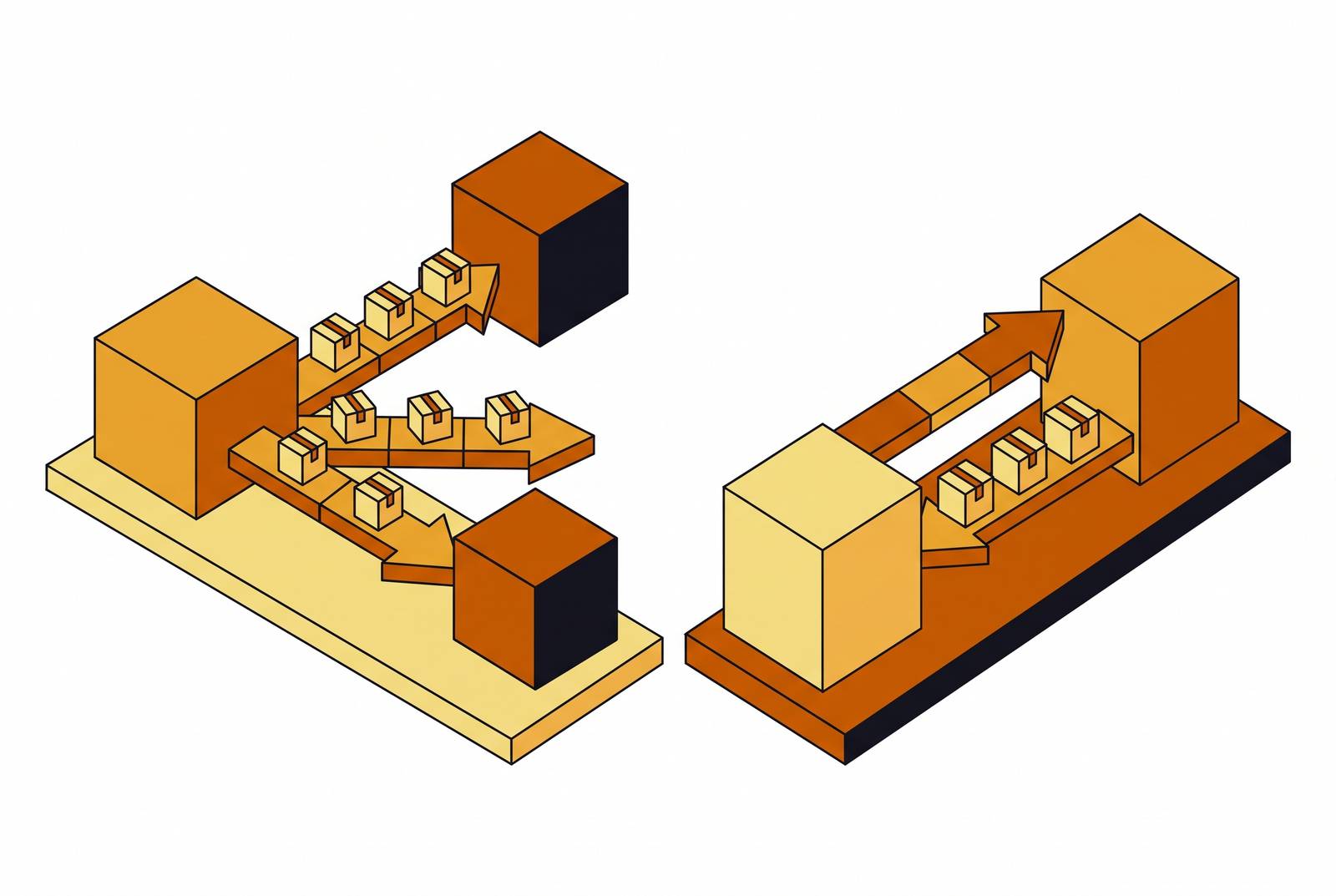
Every argument about webhooks versus APIs collapses to one question: who starts the conversation. With an API, the client asks. With a webhook, the server tells. That's the whole distinction, and once it clicks, every follow-up question about speed, cost, and reliability answers itself.
An API works on request-response terms. The client sends an HTTP request to an endpoint, the server processes it, and a payload comes back. The client controls the timing entirely. A webhook flips that script. The consumer registers a URL once, and from then on, whenever an event fires on the provider's side, the provider sends an HTTP POST to that URL with the event payload. Nobody has to ask.
This is why people call webhooks the "reverse API." With a normal API, you call the provider. With a webhook, the provider calls you. Moesif's guide puts the dividing line about as cleanly as it can be put: with an API, you initiate; with a webhook, the other side initiates. Both ride on the same protocol, HTTP, but differ in direction, and that direction changes everything downstream.
What APIs do and when to use request-response
APIs earn their keep whenever the client needs to control the timing, scope, and shape of what it's asking for. A REST API call runs a simple sequence: the client sends a request with a method, an endpoint, headers, and maybe a body; the server authenticates the request, processes it, and returns a status code along with a JSON or XML payload. That loop, done a few billion times a day across the internet, is the quiet workhorse of modern software.
REST isn't the only flavor. SOAP handles XML with strong enterprise-grade security baked in. GraphQL runs through a single endpoint and lets the client specify exactly which fields it wants, which cuts out the over-fetching that plagues rigid REST responses. gRPC runs on HTTP/2 and is built for fast, efficient communication between microservices. WebSocket keeps a persistent, two-way channel open for continuous streams, more useful for live data feeds than for one-off asks.
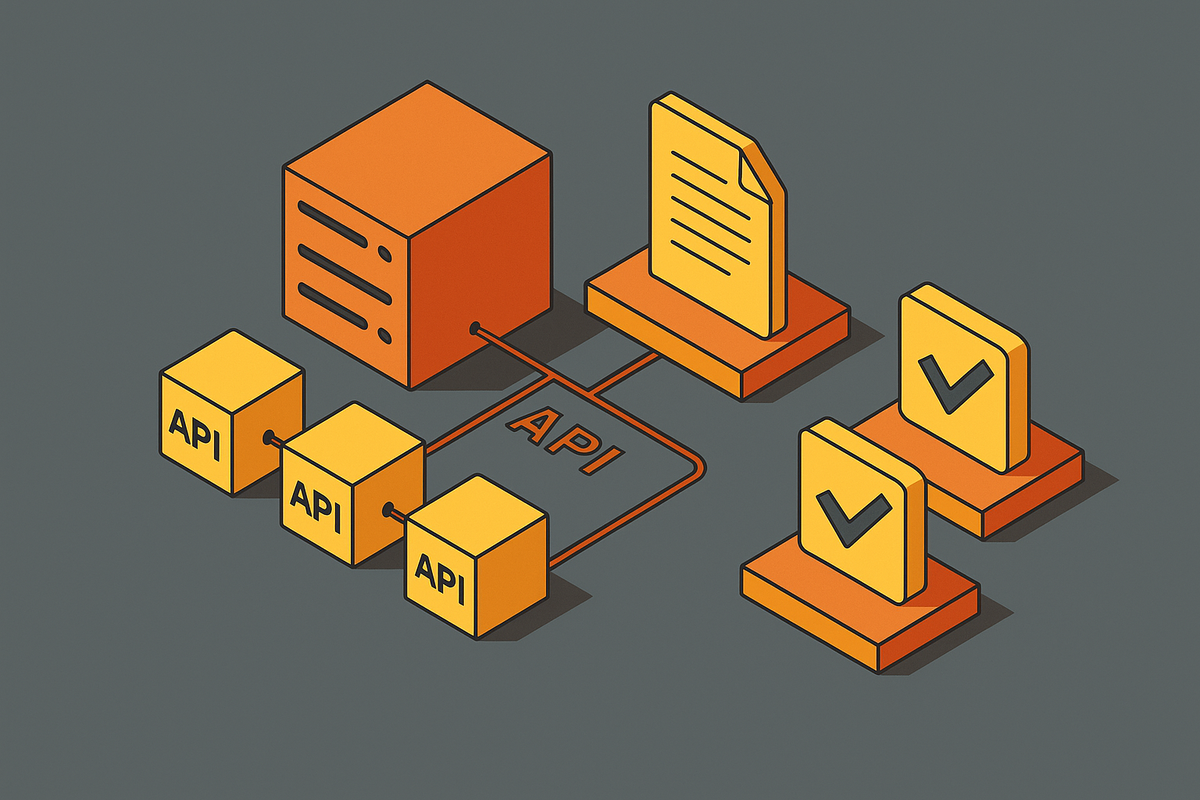
The common thread across all of them is control. APIs fit anywhere the client needs to decide, on its own schedule, what to pull or push. Searching a customer's order history from the last 30 days is a job for an API. So is creating a new record: SuperTokens' guide points to Trello's API, where developers POST to the /cards endpoint to create a card at the exact moment they choose, with exactly the fields they want. Core dna's guide offers a cleaner business example: a finance team wants to pull all expense data from a management system into an ERP system at the end of each day. The team owns that clock. There's no event to wait for, no outside trigger, just a scheduled task on their own terms. That's an API doing exactly the job it was built for, and it does that job well.
How polling turns a capable tool into structural waste
Polling is what happens when someone asks an API to do a webhook's job, a mismatch baked into the method rather than a rough edge that better tuning fixes. The mechanism is simple enough to sound harmless: the client queries an endpoint on a fixed interval, every 5 seconds or every 60 seconds, hoping something new happened since the last check. The loop's math turns ugly fast the longer it runs.
Svix's analysis puts the useful-hit rate of a typical polling loop at around 1.5 percent. That means roughly 98.5 percent of every request a polling system sends comes back empty, a round trip for nothing, discarded the moment it lands. Picture mailing yourself a postcard every five seconds just in case something interesting happened at your house. Almost every single postcard says "nothing yet." The cost of mailing it isn't zero just because the news inside is.
Latency compounds the waste. If an event fires one millisecond after the last poll, the system has no way of knowing until the next interval rolls around. A 60-second polling interval means an average discovery latency of 30 seconds, even when nothing failed and everything behaved exactly as designed. The delay is the architecture working as intended, and the intended behavior is slow.
Scale turns the waste structural. Polling every 5 seconds on behalf of tens of thousands of users means the API has to absorb that volume of requests per second, whether or not anything actually changed for any of them. TechConcepts' integration guide puts the multiplication at 10,000 real events a month producing tens of thousands of API calls at a 1-minute polling interval, many times more traffic than there were events worth knowing about. That load is entirely self-inflicted, manufactured by the method itself rather than by genuine demand.
Providers respond the way any sensible host responds to a guest who keeps knocking every five seconds: they cap it. Push past the rate limit and the response comes back HTTP 429, "Too Many Requests." At that point the system built to catch events in real time is instead getting locked out, which delays the very events it was polling to catch. Polling is easier to set up and cheaper to run at small scale, and that's worth granting honestly. But the simplicity disappears exactly when the system starts to matter, at production volume, and the staleness built into the interval doesn't go away no matter how aggressively the interval gets tuned. Checking more often just means paying the toll more often for the same empty mailbox.
Where webhooks fit naturally
Webhooks invert who has to pay attention, putting the burden of noticing a change on the provider instead of the consumer. The consumer registers a public URL once. From then on, when an event happens on the provider's side, the provider sends an HTTP POST to that URL carrying a JSON payload describing what happened. Nobody has to ask, nobody has to guess an interval, and nobody mails themselves an empty postcard every five seconds.
The speed difference isn't subtle. CUT
A state change on one side needs to be known on the other side immediately, not eventually, and that's where the natural fit shows up. GitHub pushes trigger pipeline runs through a webhook, and when the pipeline finishes, a second webhook kicks off deployment. No developer sits around refreshing a dashboard waiting for a build to start. A single Shopify order shows just how far one webhook event can cascade: the new order triggers a webhook that creates a shipping label through ShipStation, which then deducts inventory in the warehouse system the moment the label gets created. The same order also adds the customer to a Mailchimp list and creates an invoice in QuickBooks. One event, four separate systems reacting, and not a single poll involved anywhere in the chain.
Core dna's example is smaller but makes the same point: a webhook notifies a marketing Slack channel every time a document gets downloaded. Nobody on the marketing team checks a dashboard for that. The channel just stays current, quietly, in the background, the way a good assistant handles a task without being asked twice.
The operational complexity webhooks shift onto the consumer
Webhooks don't erase complexity, they relocate it. The wasted API calls disappear, but delivery reliability becomes the consumer's problem, and that includes retries, deduplication, signature verification, and knowing when something silently failed.
The most dangerous failure mode is the timeout-induced duplicate. If a handler finishes its work but the HTTP response gets back to the provider after the provider's timeout window closes (often somewhere between 5 and 15 seconds), the provider assumes the delivery failed and retries. The handler, having already done its job once, now does it again. A charge gets processed twice. An email goes out twice. Nothing crashed. The system just took a few seconds too long to say "got it."
That's why idempotency isn't optional for a webhook consumer, it's load-bearing. Providers retry on failure by design, so a transient network hiccup can make the same event arrive more than once. Handlers need to check the event's unique ID and ignore repeats, because without that check, a single transient network hiccup turns into a duplicate charge or a duplicate customer email, and neither of those looks good in an audit log.
The security surface grows too. A webhook callback URL is a public endpoint by definition, so firewalls and networks have to accept calls from the outside world, and that opening needs a web application firewall and API gateway protection standing in front of it. Signature verification is close to universal practice (HMAC-SHA256 appears almost everywhere), but the exact payload being signed isn't standardized across providers. Stripe prepends a timestamp to the payload before signing it. Shopify signs the raw request body with no timestamp involved. Each integration needs its own implementation, tuned to that provider's specific signing scheme, and copying one provider's verification code onto another provider's webhook will quietly fail.
Retry windows vary just as widely. Stripe retries delivery for up to 3 days in live mode. Shopify retries 8 times over 4 hours and may auto-delete the webhook subscription entirely after 8 consecutive failures. Svix runs roughly 8 attempts spread across about a day. A team juggling webhooks from all three needs to track three different failure clocks, each with its own consequences for missing the window.
None of this makes webhooks the wrong choice. It makes them a choice that comes with homework. A queue sitting in front of the processing layer absorbs a burst of deliveries and keeps events from getting dropped during downtime, which makes it a requirement for any team handling webhooks at real scale. And for teams that run webhooks as a publisher rather than just a consumer, a delivery dashboard showing what went out, what failed, and why isn't optional either. Without it, the support queue fills up with customers asking why something that was supposed to happen automatically never happened at all.
How Stripe, Shopify, and Twilio have moved beyond the HTTP endpoint model
The most advanced platforms have started solving consumer reliability by getting the consumer out of the business of hosting a public endpoint at all. Instead of sending an HTTP POST to a URL the consumer has to keep online, patched, and scaled, these platforms deliver events directly into managed cloud infrastructure built for exactly this job.
Shopify has extended its Webhook Subscription API to support Amazon EventBridge and Google Cloud Pub/Sub. A high-volume merchant can route order events straight into a managed queue instead of a web server, which sidesteps the concurrency limits that come with handling a burst of simultaneous HTTP POSTs on a single endpoint.
What changes in practice is who absorbs the traffic spike. The consumer no longer has to keep a public HTTPS endpoint standing by, ready to catch a sudden flood of concurrent requests on a busy sales day. The cloud queue does that job instead, built by people whose entire business is absorbing exactly that kind of burst.
That shift reframes the whole debate. That shift reframes which question matters: not "webhook versus polling" but "managed event streaming versus a custom HTTP endpoint you maintain yourself." That's the direction the largest platforms are heading, and it's worth being honest that most integration teams aren't there yet. A small team hooking into Stripe or Shopify today is still, in most cases, standing up its own endpoint and writing its own retry logic. The managed-infrastructure path is where the biggest players are moving the center of gravity, not yet the default for everyone building an integration this week.
Why the two mechanisms belong together in most production systems
None of this resolves into a clean winner, because the production-grade answer was never going to be a single mechanism. It's a two-path architecture: webhooks handle real-time delivery, and periodic API polling serves as the fallback that catches whatever the webhook missed.
The gap is real and worth naming specifically. Network failures happen. Endpoints go down for maintenance or crash at the wrong moment. Provider-side retries eventually run out, whether that's Stripe's 3 days, Shopify's 4 hours, or Svix's roughly one day. When the retries exhaust, the event doesn't try again; it's gone, unless something else is watching for that kind of gap.
The emerging consensus handles this with a belt-and-suspenders setup: webhooks carry the overwhelming majority of events in real time, and an hourly or periodic API poll checks for anything that fell through during a network blip or a window of downtime. That poll isn't there to replace the webhook, it's there to audit and recover what the webhook already tried and failed to deliver.
Celigo's "Webhook vs API" post lays out what that combined pattern looks like in an order-to-cash workflow. An ecommerce platform fires a webhook the moment an order gets created. The integration workflow then calls an ERP's REST API to validate inventory against that order. Later, a logistics provider sends a webhook when the order ships. The workflow responds by calling a CRM API to update the customer record. Webhooks trigger the workflow at each step; APIs do the retrieving and updating once triggered. Each mechanism does the job it's actually built for, and the system only works because neither one is asked to do the other's job.
There is no winner in the webhook-versus-API debate, because the two mechanisms were never actually competing. One tells you something happened. The other lets you go check, confirm, and act on it. Production systems that last are the ones built by people who understood that distinction before they wrote a single line of integration code.