Orchestration Layer Responsibilities in an API Platform
How orchestration layers coordinate multiple backend services into single consistent responses.
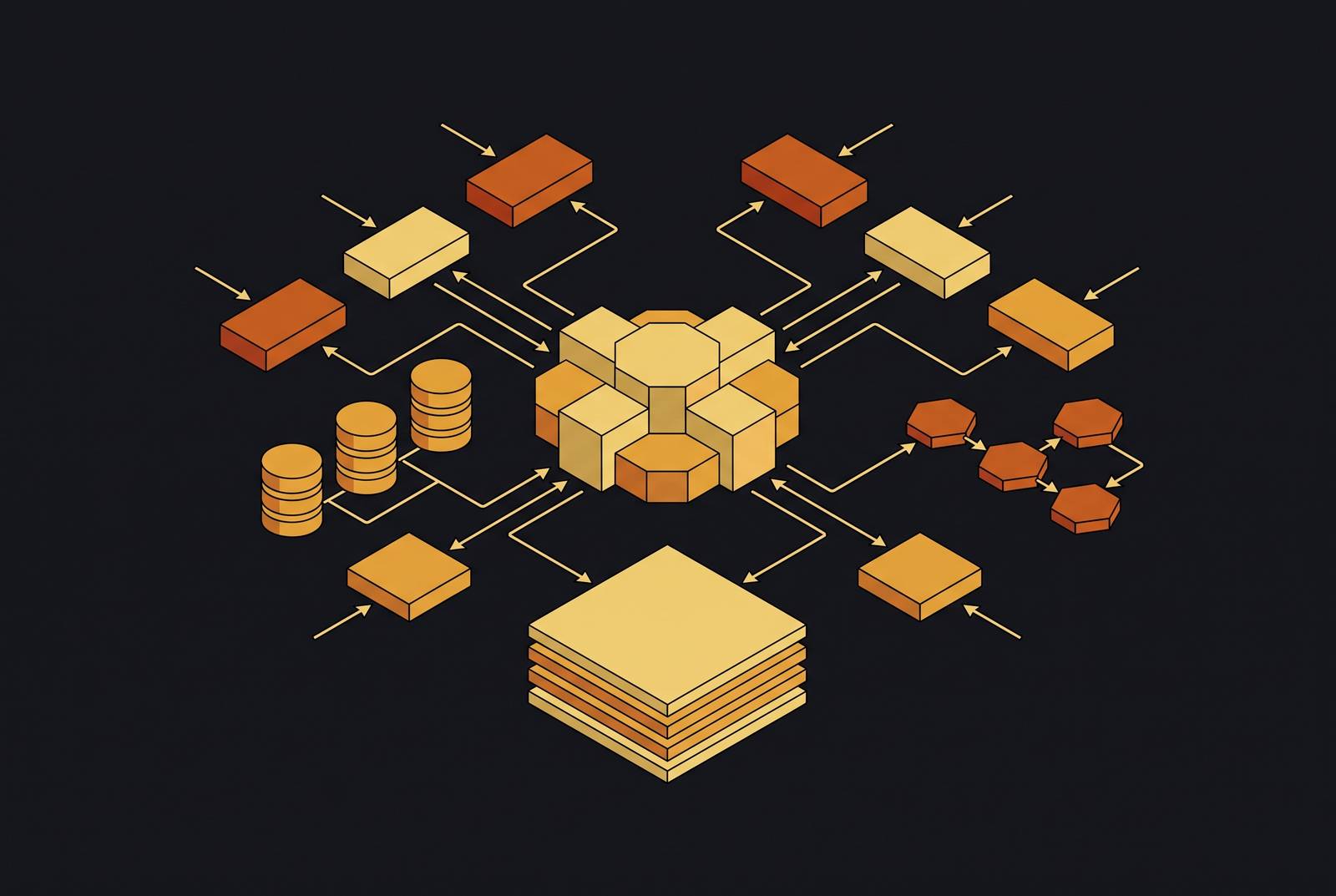
An orchestration layer is the thing that lets a client call one endpoint and get back one clean answer, even when three or four services had to run behind the scenes to build it. Think of it as calling one contractor instead of calling a plumber, an electrician, and a drywall guy separately and hoping they show up in the right order.
The conductor-and-orchestra metaphor gets used a lot here, and it's fine as far as it goes: one baton, many instruments, everybody plays on cue. But metaphors don't tell you where to put your error handling or how to structure a retry policy, so let's get more precise.
Start with orchestration versus choreography, because people mix these up constantly. Choreography is decentralized. Services react to events on a message bus, nobody's in charge, and the whole thing works like a group chat where everyone just responds when they feel like it. Orchestration is centralized and command-driven. Something sits in the middle, tells each service what to do and when, and keeps explicit control over the sequence. Neither approach wins in every case. If you need an auditable, predictable process, orchestrate it. If you need services reacting to events without a bottleneck, choreograph it.
Orchestration also isn't the same as cloud automation, even though the two get lumped together in vendor decks. Automation handles one task: spin up a server, done. Orchestration handles the dependencies between a bunch of automated tasks. Domo's 2026 piece on cloud orchestration frames it well: provisioning a server is automation, but provisioning it, configuring it, registering it, monitoring it, and handling errors at each of those steps in the right order constitutes orchestration. That's a meaningfully bigger job.
And orchestration isn't a gateway either. Gateways sit at the edge and handle routing and authentication, kind of like a bouncer checking IDs at the door. Orchestration owns what happens after you're inside, the actual workflow logic. Gateways sit at the edge and handle routing and authentication, kind of like a bouncer checking IDs at the door, while orchestration owns what happens after you're inside, the actual workflow logic, and that separation of concerns appears throughout this piece.
VMware became synonymous with virtual machines, and Kubernetes became synonymous with containers. In both cases, the coordination layer outlived the hype cycle around the underlying primitive. That's usually how you can tell which part of a new stack is actually going to matter in five years.
The five problems that make an orchestration layer necessary
Deploy anything at real scale and the same five problems appear every time, no exceptions: scheduling, permissions, health monitoring, state management, and auditability. None of these get fixed by making the underlying service better. A faster database doesn't solve a scheduling conflict. A more secure API doesn't solve inconsistent permission checks across five different services. These problems get solved by building a coordination layer above the services, not by polishing the services themselves.
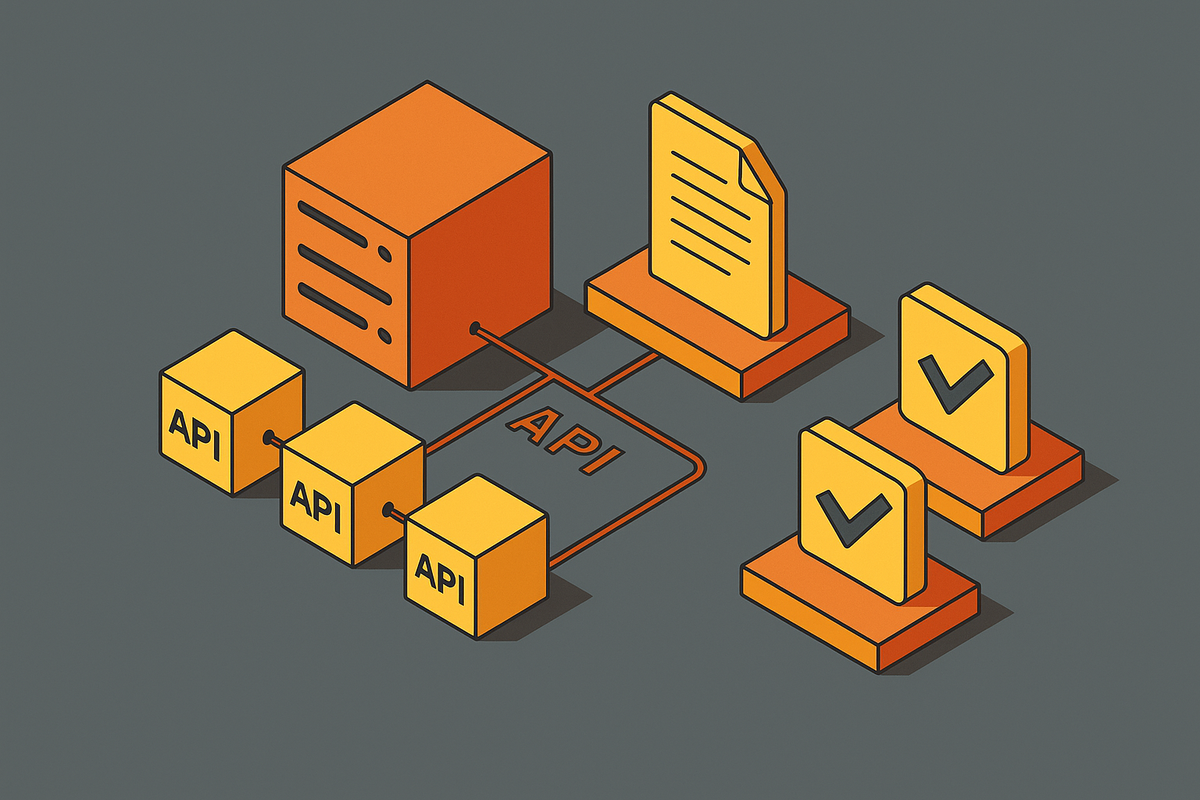
Picture a client that needs a profile, an eligibility check, and account data to render one screen. Without orchestration, the client calls a REST profile service, a REST eligibility service, and a GraphQL account service directly, three round trips, three failure points, three places to get authentication wrong. With orchestration, the client calls one endpoint. The orchestration layer fans out to all three in parallel, merges the results, and returns a single payload. The client has no idea three calls happened. It doesn't need to.
Skip the coordination layer and each of those five problems gets solved differently by each team, on each service, at each layer. One team handles retries with exponential backoff, another team doesn't handle retries at all. One service logs everything, another logs nothing useful. The inconsistency is not visible in a demo. It shows up at 2 a.m. during a traffic spike, when the seams between services turn into cracks.
This gets urgent fast once you factor in how many AI providers a typical enterprise stack actually runs. The average enterprise runs 4.2 different LLM providers. Without a coordination layer sitting above all of them, there's no consistent way to enforce governance or sequencing across providers that don't share a vendor, a schema, or a rate-limiting policy. That's an operational gap, not a hypothetical one.
Request routing and service coordination as the orchestration layer's first job
The most basic job an orchestration layer does: take one inbound call, fan it out to multiple backend services (sometimes in parallel, sometimes one after another), then merge the results into a single response. Simple to describe, easy to get wrong in practice.
Routing comes in two flavors. Static routing always calls the same services in the same order, no matter who's asking or what they're asking for. Conditional routing makes decisions on the fly: route premium members to a faster backend, or if inventory hits zero, skip the order flow entirely and fire off a "notify me" API instead. That decision doesn't belong in the client's code. It belongs in the orchestration layer, where it's visible, auditable, and changeable without shipping a new app release.
Pulling routing logic out of client code isn't just tidier, it's genuinely safer. Frontend code that hardcodes business rules about which backend to call is a bug waiting for a product manager to change the rules. Keep that logic in one place and you get a single spot to audit when someone asks "why did this user get routed to the slow server?"
Whether you call three services in parallel or in sequence changes the response time and correctness: parallel calls save real latency when the services don't depend on each other, but calling them in the wrong order when one depends on another's output produces more than just a slow response. Call three services in parallel when they don't depend on each other and you save real latency. Call them in the wrong order when one depends on another's output, and you don't just get a slow response, you get a wrong one. The orchestration layer has to make that call explicitly, every time, for every workflow.
Conditional routing based on business rules (who gets the premium backend, who gets throttled, who gets denied) is also an access-control decision, which makes it a governance decision. Conditional routing based on business rules (who gets the premium backend, who gets throttled, who gets denied) is also an access-control decision. Performance and policy end up living in the same piece of logic, whether anyone planned it that way or not.
Data transformation and aggregation across services with incompatible formats
Different services speak different languages, and not in a charming, multicultural way. One API returns JSON. Another expects XML. A third, usually the oldest one nobody wants to touch, still runs on a SOAP envelope from a decade ago. Left alone, none of these three will ever agree on a common format, and the client shouldn't have to know or care.
The orchestration layer is the translator. It normalizes all of it before anything reaches the client, so the client just sees one consistent shape no matter what's happening upstream.
Four things the layer needs to handle here, and they're distinct jobs even though they sound similar:
- Splitting: one response from upstream gets broken into multiple downstream payloads
- Merging: several upstream responses collapse into a single client-facing response
- Routing: transformed data gets sent to whichever downstream service needs it next
- Format conversion: actual structural translation between schemas, not just swapping XML tags for curly braces
Legacy integration is where this gets tested hardest. Mixing REST and SOAP used to be one of the more painful parts of enterprise integration work, mostly because someone had to hand-write a translation layer for every pairing. An orchestration layer absorbs that pain once, centrally, so legacy services can participate in modern workflows without a rewrite. Nobody has to migrate the 15-year-old SOAP service just to make it play nice with a new mobile app.
The bigger principle: business process logic, gateway concerns like routing and authentication, and core service logic are three different things and they belong in three different places. Data transformation lives in the orchestration layer. Scatter it across individual services instead, and every service ends up maintaining its own half-baked translation code, which is how you get five slightly different JSON schemas for the same customer record.
Security enforcement, authentication, and governance at the orchestration boundary
Because the orchestration layer sits as the single coordinator for a workflow, it's also the one place where security policy can actually be enforced consistently. Let clients call services directly and you get consistency in theory only, since every direct path is one more place policy can slip.
A few things fall squarely on the orchestration layer:
- Handling OAuth flows between microservices, rather than making every service manage its own token dance
- Enforcing role-based permissions, so only the data a given role should see actually reaches that role
- Screening requests for malicious payloads before they ever touch a backend service
Rate limiting sits here too. A public API surface invites traffic spikes, sometimes legitimate, sometimes not, and the orchestration layer can cap calls, page results, and cache responses in memory so repeat queries don't hammer the backend every single time. That caching layer alone can take a meaningful bite out of backend CPU load during a spike.
Centralized enforcement produces a nice side effect: centralized audit trails. Every access decision gets logged in one place instead of scattered across a dozen service logs that nobody wants to reconcile during a compliance review.
That's where the stakes get real. Tools that solved one layer of the stack well left governance and orchestration gaps that blocked the thing from ever reaching production. Picking a great model isn't the hard part anymore. Governing it is.
Error handling, circuit breaking, and fault isolation as explicit design responsibilities
Without centralized error handling, one flaky downstream service quietly drags down the entire response, and nobody notices the failure surface until it raises problems in production that are hard to trace back. That's the failure mode orchestration exists to prevent.
Here's what needs to live in the orchestration layer, not bolted on after the first outage:
- Retries, configured per step, so a hiccup in one service triggers a retry of that step, not a re-run of the entire workflow
- Timeouts, also per step, so a slow service can't hold the whole response hostage indefinitely
- Circuit breakers, which stop sending traffic to a service that keeps failing and fail over automatically instead
- Graceful degradation, where one failed service means a partial response instead of a total collapse
- Escalation paths, where outputs below a confidence threshold get kicked to a human instead of shipped as-is
Picture an LLM provider going down mid-workflow. A well-built orchestration layer fails over to a backup provider automatically, based on a policy set up in advance. Nobody's paging an engineer at 3 a.m. to manually flip a switch. The switch was already built.
Step-by-step execution tracing matters here too. Capturing a full trace of every execution means post-incident diagnosis happens at the workflow level.
None of this works if it's treated as an afterthought. Fault isolation has to be designed into the orchestration layer before the first production outage, not patched in after.
State management and workflow sequencing when operations cannot be stateless
Sequencing sounds simple until you actually try to map which operations can run in parallel and which absolutely cannot. Run things out of order and you don't just get a slower result. You get a wrong one, which is a much worse Monday.
State management at the orchestration layer covers a handful of concrete mechanisms:
- Shared queues, where agents claim tasks so two agents never grab the same job at once
- Completion callbacks, where one agent finishing its work triggers the next step automatically
- Checkpoint data, so a workflow that fails partway through can restart from its last good state instead of from zero
- Resource negotiation, arbitrating when multiple agents compete for the same compute
- Parallel synchronization, holding parallel branches until all of them finish before the workflow moves forward
Idempotency deserves its own mention here, because it's the design principle that makes all of the above safe. Build a step so that running it twice produces the exact same result as running it once, and retries stop being scary. Without idempotency, a retry can double-charge a customer or duplicate a database entry. With it, retries become boring, which is exactly what you want from infrastructure.
As autonomous agents start operating over longer stretches of time, hours or days instead of milliseconds, state management becomes the thing standing between a working system and one where tasks get lost, duplicated, or executed in the wrong order without anyone noticing until it's too late.
Observability as a first-class responsibility, not an operational add-on
Every workflow execution passes through the orchestration layer. The orchestration layer is also the one vantage point from which the entire workflow can be logged, traced, and watched. That's a structural advantage.
Compare that to service-level monitoring alone, and the gap is obvious. Orchestration-level observability gives you end-to-end traces instead of a pile of disconnected per-service logs. It tells you which specific step in a five-service workflow is slow, instead of just telling you the overall response took too long. It surfaces errors faster because the whole failure surface is visible from one place instead of five. And it reveals patterns over time, the kind of slow drift that turns into an outage weeks later if nobody's watching for it.
Observability doubles as the audit trail. The same place that enforces security and routing policy also captures every step and every decision, which makes the governance story and the monitoring story the same story.
A zero in a trace always needs an explanation. Broken instrumentation and a genuine gap in the workflow look identical on a dashboard if observability wasn't designed in from the start. Confusing the two isn't a minor slip. An honest health report is not the same as a false sense of security.
IBM's 2026 "AI in motion" study found that organizations running an orchestration-led AI governance layer were around 13 times more likely to scale AI successfully than peers without one. Observability is a core piece of what makes that governance layer actually function, rather than just exist on a slide.
Dynamic resource allocation and scaling as an orchestration-layer decision
Scaling compute up during peak demand and back down during quiet periods, without someone manually flipping switches, is a policy decision, and it belongs at the orchestration layer.
Take a retailer bracing for a holiday traffic spike. Rather than over-provisioning infrastructure year-round just to survive a two-week surge, the orchestration layer can route overflow traffic to lighter models automatically once primary endpoints hit capacity. That's orchestration doing the job a much more expensive infrastructure budget would otherwise have to do.
No individual service has the vantage point to make that call well. A single service knows its own load. It doesn't know what every other service in the stack is doing right now, which is exactly the information you need to decide where to route overflow traffic. Only the coordination layer sees the whole board.
With enterprises running 4.2 LLM providers on average, this scaling decision isn't confined to one vendor's infrastructure either. The orchestration layer can spread load dynamically across providers, which matters a lot when one provider's capacity gets tight and another's doesn't.
Skip this and the alternative is provisioning for peak load, permanently, whether you're using that capacity or not. That's a real, recurring cost, and it's one of the more avoidable ones in a cloud budget.
The dollars at stake aren't small. The global AI orchestration market is projected to pass $12 billion and grow past $40 billion by 2032, at roughly a 20% compound annual growth rate. That's not a niche corner of the infrastructure market anymore.
How agentic workflows are extending each of these responsibilities into new territory
Agentic AI orchestration is a coordination layer for AI agents, and the tools and systems those agents touch, so they work toward one goal instead of running off in their own directions. It decides which agent runs when, manages handoffs between them, aggregates their outputs, and enforces governance across all of it. Same job description as everything above, just applied to agents instead of services.
Every core responsibility covered so far stretches under agentic conditions. Routing now means deciding which agent takes a task, not just which service handles a request. State management gets harder because agents can run for hours or days, so checkpointing is the thing keeping work from vanishing. Error handling gets messier too, because agents fail in more complicated ways than a service throwing a typical HTTP error code. Partial task completion is a real state an orchestration layer has to plan for, not an edge case to shrug off. And governance gets stricter, not looser, once agents start acting autonomously on a user's behalf.
The adoption curve backs this up. Gartner predicts 40% of enterprise applications will include task-specific AI agents by 2026, up from under 5% in 2025. A large share of organizations are already experimenting with AI agents, and many are scaling agentic systems in at least one business area. That's a fast climb for something that barely existed a couple years ago.
The lab automation example makes this concrete. OpenAI's GPT-5 autonomously ran 36,000 protein synthesis experiments inside Ginkgo Bioworks' cloud lab, a result announced by press release on February 5, 2026, just ahead of SLAS 2026 in Boston (Feb. 7 to 11). Six rounds of closed-loop experimentation, minimal human intervention along the way. At the same time, Automata announced its LINQ platform as a cross-portfolio orchestration layer for Danaher's instrument lineup, and Cenevo debuted AI agents for protocol conversion built with 21 CFR Part 11 compliance support in mind. Three separate announcements, same underlying ask: manage autonomous, multi-step scientific workflows at a scale and complexity that earlier API orchestration patterns were never built to handle.
Autonomous doesn't mean ungoverned, though. If anything, the more independently an agent operates, the tighter the orchestration layer's policies need to be, because there's no human in the loop catching the mistake before it compounds across a huge number of subsequent experiments.